
Opinion
The Real Endgame? Israel, Annexation, and the Global Strategy Behind the Chaos
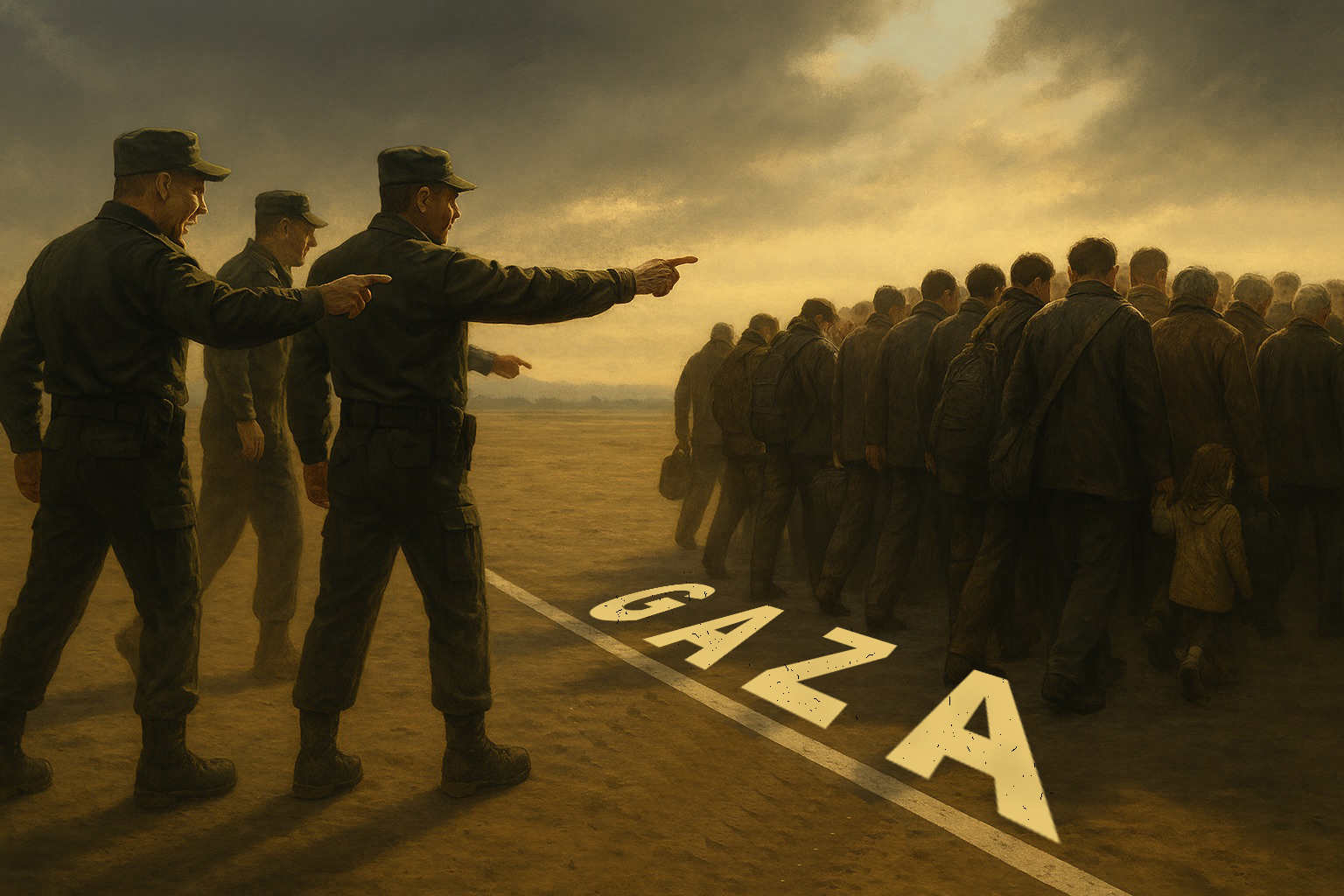
Televised Genocid, Ethnic Cleansing, Annexation.. All for the Grand Israel?


Beneath the headlines of war, displacement, and controversy lies a much colder and more calculated agenda. The current actions of the Israeli government suggest something far more strategic than mere retaliation or defense. What if the war in Gaza, the expansion in the West Bank, and the rising civilian death toll are not tragic miscalculations, but pieces of a broader geopolitical plan? One that includes territorial domination, political cleanup, image control, and global positioning in the middle of an escalating global energy crisis. Israel’s true endgame may not be mere survival, but regional control, resource access, and long-term dominance, with the Palestinian population caught in the crosshairs.
At the same time, a growing portion of global public opinion is beginning to recognize the Israelo-Palestinian conflict as genocide. International jurists and human rights organizations have increasingly used this terminology UN Human Rights Council, 2023. Yet this perception rarely finds its way into mainstream news. Coverage is muted, reframed, or dismissed altogether, not because the sentiment is absent, but because it is being systematically suppressed. Many are realizing we are not truly living in a fair democratic system, but in societies where powerful decision-makers dominate strategic sectors law-making, media, finance, and real estate. When such sectors are monopolized by a small group, populations become vulnerable and dependent, leaving little room for dissent. Those who attempt to speak objectively about the conflict risk being labeled antisemitic, silenced, or even fired. Corporations are pressured through financial institutions and lobbying networks to avoid aligning publicly with justice, fairness, or anti-colonial narratives, lest they lose investors, advertising contracts, or state subsidies. This deeper dynamic of power explains why, despite the rising recognition of genocide among ordinary people, lawmakers refuse to use that word, words they would have used readily if the suffering were their own.
1. Land, Power, and Erasure: The Immediate Objective

The most visible phase of Israel’s current strategy centers around Gaza and the West Bank. Far-right Israeli ministers have grown increasingly open about their goals. Calls for the “voluntary emigration” of Palestinians, rejection of a two-state solution, and aggressive settlement expansions are not accidental slips; they are the roadmap Haaretz, 2024. The aim is total control of historic Palestine, from the Jordan River to the Mediterranean Sea. Gaza has been reduced to rubble, nearly two million Palestinians displaced, infrastructure obliterated, entire neighborhoods flattened, and civilians, including children and aid workers, killed in what many legal scholars describe as textbook cases of ethnic cleansing or even genocide International Court of Justice filings, 2024.
Israel’s rhetoric of self-defense masks a deeper truth: the methodical dismantling of any viable Palestinian future. In the West Bank, settlements continue to grow. Outposts once considered illegal are legalized retroactively. Palestinian land is divided, surrounded, and choked off. The message is clear: no path to sovereignty will be left intact.
2. Netanyahu: The Useful Villain
Benjamin Netanyahu is not acting alone. He is supported by a coalition of ultra-nationalist and religious parties who see Palestinian existence as a demographic threat. But even within Israel, Netanyahu is a controversial figure, battling corruption charges and mass protests. So why is he still in power? Because he’s useful. He’s the political figure willing to carry out the dirtiest phase of this operation. The war, the crackdown, the suppression of dissent, and the rejection of international pressure, Netanyahu is the lightning rod. While he absorbs global outrage, the territorial goals are pushed forward aggressively. But once the land is secured, once Gaza is emptied and the West Bank fractured beyond repair, Netanyahu becomes a liability. And that’s the next move.
3. The Political Reset: Rebranding With Blood Still on the Ground
When the annexation is a fact, not a possibility, the Israeli establishment will need to clean its image. That starts by removing the face of the chaos. Netanyahu will be thrown out, either by elections or legal convictions. His fall will be broadcast as a sign that Israel is returning to sanity, moderation, and democracy. A new leader, more polished, more diplomatic, will rise. They’ll apologize for excesses, hint at regret, and promise reconstruction. But the reality won’t change. The land will remain under Israeli control. The Palestinians will still be stateless, scattered, and silenced. This rebrand is not a retreat. It’s a reintroduction. A way to retain the gains while shedding the guilt.
4. Israel’s Geostrategic Value in a Global Energy Crisis
The timing of this aggressive strategy is not accidental. The world is entering a prolonged energy crisis. Fossil fuel production is tightening, wars disrupt supply chains, and Western nations scramble to secure Middle Eastern oil and gas without being beholden to unstable regimes. Here, Israel becomes invaluable. Positioned at the edge of the Arab world, bordering Egypt, Jordan, Lebanon, and Syria, it offers the West something it cannot afford to lose: a militarized, Western-aligned outpost in the heart of the region. A launchpad, a surveillance hub, a logistics corridor. Whether through pipeline routes, shipping corridors like the Red Sea, or aerial dominance, Israel’s geography is power. And with Gaza neutralized and Palestinian resistance subdued, Israel becomes the perfect partner for energy and military logistics Brookings Institution, 2023.
5. Normalization Without Resolution
The Abraham Accords demonstrated that Arab governments will normalize relations without a Palestinian settlement. Economic interests outweigh moral outrage. Saudi Arabia, the UAE, Bahrain, and Morocco perceive alliances with Israel as advantageous. Israel is wagering that Arab publics will grumble but not revolt, while Western allies such as the U.S., UK, and Germany continue to supply weapons and veto international sanctions. In this new order, Palestine is not the priority; stability and energy security are. And Israel positions itself as the indispensable middleman.
6. Weaponizing Morality: From Perpetrator to Peacekeeper
Once Netanyahu is removed and replaced with a softer face, Western media will pivot. Stories will shift from destruction to reconstruction, from annexation to peacebuilding. Israel will present itself as a stabilizer, offering to rebuild Gaza, but only on its terms. It will invite international aid, establish new checkpoints, and propose limited autonomy. This will not be peace, but pacification: a managed conflict turned into a managed occupation. For a weary world desperate for stability, that will appear sufficient.
7. What Happens to the Palestinians?
In this vision, the Palestinian people become a memory. Displaced to Egypt, Jordan, or scattered worldwide, they are expected to vanish from political relevance. Those who remain will live under permanent control, stripped of rights, movement, and sovereignty. They will be offered jobs, aid, and partial freedoms, but never a state. The world will adjust. Western governments will rationalize it, Arab leaders will remain silent, and Israel will stand victorious, not because it fought harder, but because it played the long game.
The Strategy Beneath the Smoke
This is not about religion. Not about defense. Not about revenge. It is about real estate, power projection, and geopolitical leverage. Annexation is disguised as security, war as necessity, displacement as defense. Netanyahu is the mask, not the mastermind. Once removed, the machine will keep running, repainted and repackaged.
The vision of a Greater Israel is made possible in large part through powerful allies such as the United States, France, and the United Kingdom, whose support ranges from the supply of advanced weaponry and nuclear technology protocols to preferential economic agreements that keep Israel’s economy strong. U.S. tenders often tilt unfairly in Israel’s favor, and without this external backing, a young nation like Israel could never have amassed such disproportionate power so quickly. The current reality in Gaza is not a tragic accident of history but a carefully engineered outcome designed to secure Palestinian lands while ensuring that Israel’s allies maintain their global monopoly and status at a time when their own natural energy resources are steadily declining. Israel has become the angular rock upon which Western nations project their survival, anchoring their influence in the Middle East and helping them navigate a mounting global energy crisis.
All the while, the public’s growing recognition of genocide is muted by infiltrated voices in key sectors, ensuring that outrage never reaches its full volume. Financial pressures, media suppression, and political complicity weave together into a system where truth is not denied outright but drowned. This is the endgame: a Greater Israel, unchallenged borders, permanent control, and a world too distracted, dependent, or complicit to stop it. Unless that pattern is broken, history will not remember this as a tragedy. It will remember it as a turning point that the world watched happen, and chose to forge




Opinion
Is YouTube Protecting Quality or Capturing the AI Video Market?
YouTube’s removal of AI-generated channels with 4.7 billion views raises questions about whether it is fighting spam or protecting Google’s Veo 2 ambitions.

Opinion
How Israel Dressed Up Annexation and Forced Displacement into “Population Growth”
Israel’s claim of stunning Palestinian “population growth” is simply a headcount of the people it has pushed off their land, rebranded as “growth.”
For years, Israeli officials and their allies have repeated the same line: the Palestinian population is growing. On paper, it sounds like proof that nothing truly catastrophic is happening. If there are more Palestinians now than twenty years ago, how can anyone speak of ethnic cleansing or genocide? This demographic story is presented as neutral fact, a scientific reassurance that, despite the images of bombed cities and fenced-in lives, the situation is still “within normal limits.”
My argument is that this story is not neutral at all. It is a political construction built under occupation, where the same power that seizes land and controls borders also decides who is counted, where they are registered, and which numbers the world is allowed to see. The so-called “growth” of the Palestinian population in Gaza and the West Bank does not prove safety; it measures the scale of forced displacement, land theft, and confinement. Every additional body counted in Gaza or in fragmented West Bank enclaves is the human echo of a family pushed off its land somewhere else. In a territory carved by settlements, checkpoints, and annexation, rising headcount do not describe a healthy society, they describe a cage that has been steadily filled.
Seen this way, Israel’s own numbers betray its narrative. Either they are manipulated, or they are even more damning than intended: they show how many people have been compressed into shrinking, militarised spaces, expected to live and raise children in conditions where even captive animals would struggle to reproduce. The statistics that were meant to dismiss Palestinian suffering instead become evidence of how much land has been taken, how many communities have been uprooted, and how tightly an entire population has been trapped.
A Territory on Paper, an Archipelago in Reality
On a political map, the West Bank appears as one continuous piece of land, roughly 5,655 km² in area. In theory, that looks like enough space for a few million inhabitants. In reality, Palestinians do not live in a normal territory, they live in fragments.
Around 60% of the West Bank is designated Area C, where Israel retains full security and planning control. Only a tiny fraction of this land is zoned in a way that allows Palestinians to obtain building permits; most Palestinian construction is either blocked or later demolished as “illegal”. Israeli settlements and related infrastructure occupy large areas inside this same zone. Those settlements are widely recognised as illegal under international law by the UN, the International Court of Justice, the International Committee of the Red Cross and multiple human-rights organisations, as they violate the Fourth Geneva Convention’s ban on transferring the occupier’s population into occupied territory.
Meanwhile, Palestinian homes and basic structures are demolished at record levels. In 2025, the Norwegian Refugee Council reported that in less than nine months, Israel had already demolished more Palestinian homes and structures in the West Bank, including East Jerusalem, than in the entire previous year, explicitly linking this to a wider annexation agenda. Each demolition does not just remove bricks; it removes a family from a place.
Movement across what is left is tightly restricted. UN OCHA documented 565 physical obstacles to Palestinian movement in the West Bank at the start of 2023, including checkpoints, roadblocks and earth mounds; later that year they counted 645 obstacles, an 8% increase. After the Gaza war escalated, new surveys reported around 849–900 barriers, including “iron gates” at village entrances, turning daily travel to work, school or hospital into an unpredictable ordeal.
On paper, the West Bank is a territory. On the ground, Palestinians inhabit isolated pockets, surrounded by checkpoints, settlement blocs and military zones. The land still exists, but the parts they can actually use, build on and move through freely are shrinking.
Annexed Land Has a Demographic Echo
Land is never emptied in silence. When hillsides are declared military zones, when outposts are legalised, when Palestinian houses are flattened for lack of permits that are almost never granted, the people who lived there do not evaporate. They have to go somewhere.
Documentation from the UN, NGOs and human-rights groups has, for years, shown a pattern:
- Palestinian communities in parts of Area C, East Jerusalem and rural zones are removed through demolitions, settler violence or administrative orders.
- Those displaced families reappear in denser, poorer spaces: refugee camps, urban peripheries, and, increasingly over decades, in Gaza or in a few crowded West Bank cities.

At the same time, Israel has never fully ceded control of the population registry. Since 1967, it has held ultimate authority over which Palestinians receive ID cards and are recorded as residents of the West Bank, Gaza or East Jerusalem, and it can freeze updates or block family reunification. This means the same power that redraws the map on the ground also shapes the categories on the spreadsheet: who “belongs” to Gaza, who is recognised in the West Bank, who is kept in legal limbo.
From that angle, official “growth” is not a neutral snapshot of fertility. It is the demographic shadow of annexation. Every new outpost, every “legalised” settlement, every demolition in Area C pushes Palestinians into fewer, smaller nodes, then those crowded nodes are later cited as proof that the population is simply “growing”.
Gaza as the End of the Pipeline
Gaza has become the most extreme expression of this logic. International institutions routinely describe it as an area under land, sea and air blockade for over fifteen years, with severe restrictions on the movement of people and goods in and out of the Strip. After October 2023, these restrictions tightened further, with aid agencies warning of famine conditions and a “web of obstacles” systematically blocking humanitarian convoys. For ordinary Gazans, leaving is almost impossible; for foreign journalists or aid workers, entering is allowed only under Israeli security vetting and veto.
Over roughly the last two decades, official figures show Gaza’s population rising above two million. That is routinely labelled “natural growth” and pinned solely on a high birth rate. But this increase cannot be understood apart from the wider map:
- As West Bank land is progressively absorbed into settlement blocs and closed zones, displaced Palestinians often have one direction they can legally or practically go: into already crowded areas – including Gaza.
- Israeli control over the registry and ID categories makes it much easier to reclassify or treat people as “Gazan”and much harder for anyone registered in Gaza to legally move to the West Bank or Jerusalem.
Gaza thus becomes not only an “open-air prison”, but the end-station of displacement: the place where Palestinians pushed out of other spaces eventually accumulate. Counting them there as evidence of “growth” while ignoring how and why they were forced into that enclosure is, at best, a half-truth.
Who Counts, and What They Choose to Count
Even if Palestinian institutions do much of the day-to-day statistical work, they operate inside a framework where Israel controls borders, population categories and, in key ways, access to the outside world. The result is an obvious asymmetry in how numbers are used.
When the subject is Palestinian deaths, especially in the context of recent wars, we hear constant hesitation: the numbers are “unverified”, the situation is “too chaotic”, the figures are “disputed”. Hospitals are bombed, civil registries damaged, mass graves feared but not investigated, journalists blocked from free access. The uncertainty is real – and it is always emphasised.
When the subject is Palestinian demographic growth, those doubts seem to evaporate. Fertility curves, long-term projections and smoothed population lines are presented with great confidence. The same environment that is supposedly too unstable to count the dead becomes perfectly stable when it is time to show that “they are multiplying”.
This is where the accusation hits: uncertainty is never neutral. It consistently protects Israel from having to face a clear, universally accepted death toll, while hardly ever being used to question the comforting story that Palestinians are “growing” and therefore cannot be that persecuted. In other words, doubt is reserved for the numbers that incriminate, not the numbers that reassure.
Habitat, Captivity, and Common Sense
There is a simple intuition people have about safety and reproduction. n wildlife reserves and zoos, keepers observe that many species show less interest in reproducing and display reduced fertility when their enclosure is noisy, cramped, and unpredictable. Animals sense when a habitat is unsafe; reproduction slows down or collapses. Births are not just biology; they are a fragile vote of confidence in the environment.
Now apply this basic logic to human beings in Gaza and the West Bank:
- Gaza lives under blockade, periodic bombardment and, since late 2023, large-scale destruction that has displaced around 90% of the population at least once.
- The West Bank is held under occupation, with nearly 1,000 barriers reported in recent surveys, cutting communities off from each other and from essential services.
Common sense says no parent wants a child to grow up in these conditions. Many Palestinians do, in fact, decide not to have children or to delay them for exactly that reason. Others, under economic necessity (no pension system, children as future support), cultural pressure, or simply lack of real options, still end up with families. Life continues even in cages.
What this means for the numbers is crucial:
A rising headcount in Gaza or the West Bank does not describe a thriving society. It describes a population trapped in place, without routes of safe exit, and subjected to policies that slowly shrink their living space. In such a context, any recorded “growth” says as much about confinement and crowding as it does about private choices.
My analogy is not that Palestinians are animals; it is that habitat and control matter. If even zoo managers recognize that hostile enclosures suppress reproduction, then describing Gaza and the West Bank as places of “normal demographic growth” defies basic common sense. It invites the world to treat a war-zone cage as if it were an ordinary country.
Displacement Dressed Up as Demography
Everything circles back to one key point: the way Israel uses demographic data is not just biased, it is inverted.
- First, land is seized: through settlements, demolitions, and legal tricks that transfer control of hills, valleys and neighbourhoods to settlers and the army.
- Second, people are pushed: families are uprooted from those areas and forced into smaller, already-crowded zones, camps, town peripheries, Gaza.
- Third, the registry and ID system are managed in a way that cements these shifts on paper and limits any possibility of reversing them.
Then, once this process has run for years, we are shown a demographic chart and told:
“Look, the Palestinian population has grown; how persecuted can they really be?”
From my perspective, this is the final manipulation. What is presented as “neutral evidence” of Palestinian resilience is, in reality, a blurred photograph of the crime scene. The increase in numbers does not prove that Palestinians are safe; it reveals how many have been forced to survive within ever tighter boundaries, on ever smaller fragments of their own land.
When the Numbers Turn Against Their Authors
Officially, demographic statistics are supposed to clear Israel: more Palestinians alive now than twenty years ago means there is no systematic attempt to erase them. That is the script.
But when you pull back and look at the map, the checkpoints, the registry, the blockade and the demolitions, those same numbers take on a different meaning. In a normal state, population growth might signal stability. In a system of occupation and enclosure, it signals something else: how many people you have managed to trap.
If the data are polished or manipulated, they still show a simple, incriminating reality: millions of Palestinians compressed into shrinking, militarised spaces, living under a regime that controls their land, their movement, their IDs and their sky. And if the data are broadly accurate, they are more damning still: they prove that a growing population is being held in conditions where even basic habitat, safety, space, dignity, is denied.
Either way, the figures do not wash Israel’s record. They underline it.
Israel’s government wanted demographic charts to act as a shield: a way to say “we cannot be committing a crime if they are still here.” Instead, the logic turns on itself. The very numbers meant to reassure become a quiet admission of scale, of how many people have been displaced, how much land has been taken, and how fully an entire people has been locked inside a conflict they did not choose.
In the end, that is the paradox exposed:
The more Israel brandishes Palestinian “population growth” as proof of its innocence, the more it hands the world a statistical confession of how many people it has pushed off their land and packed into enclaves. What it calls growth is, in truth, the headcount of the displaced.

Gemstones, Moissanite: The End of a Monopoly Era

Nolan Wells: The Investigation Itself Needs to Be Investigated

Black Women Climbed the Ladder: Only to Find Too Few Black Men at the Top


-

 Entertainment1 year ago
FLASH NEWS: Malcolm-Jamal Warner Dies in Tragic Drowning Accident
-

 Opinion1 year ago
The Forgotten Mothers of Israel: A Theory on the Real Bloodline of the Jewish People
-

 Politics1 year ago
Jailed for Profit: How Private Incarceration Turned Justice into Revenue
-

 Tech1 year ago
The Gatekeepers Have Fallen: How Social Media and AI Broke the Monopoly on Truth
-

 Economy1 year ago
Breaking Free: Debt, Location Freedom, and the New American Dream
-

 Sports1 year ago
Enhanced Games 2026: Where Performance Enhancing Drugs Allowed
-

 Entrepreneur1 year ago
The Resource Illusion: Why Wealth Isn’t About Being Smarter, It’s About Having Leverage
-

 Opinion11 months ago
The Quiet Motive: What Truly Drove America’s Sudden Reversal on Abortion