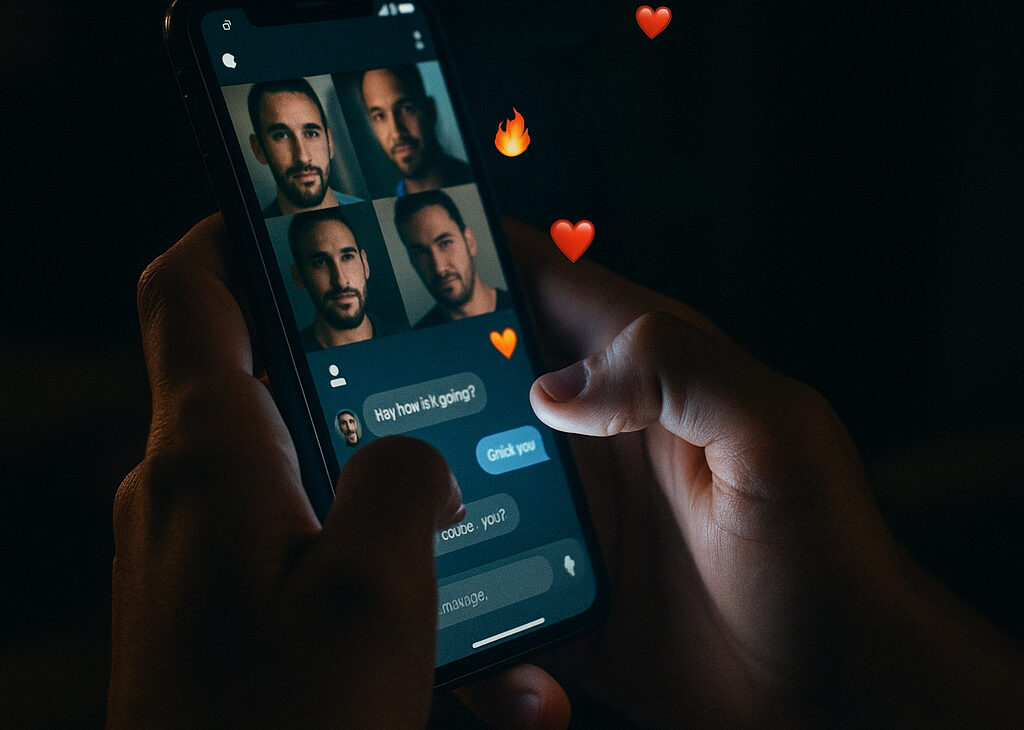
Few issues stir as much tension within the queer community as the collision of race and romantic preference. Tucked inside dating profiles and hookup bios are phrases that seem almost casual, “just into Black,” “only into Asians,” “prefer White”, but beneath these brief declarations lie deeper questions about societal conditioning, cultural dominance, and personal desire.
To some, these statements are harmless expressions of taste. To others, they are coded messages of exclusion, shaped by systems that have long equated whiteness with beauty, power, and worth. The truth, as with most things involving human complexity, lives in the tension between those views.
A Culture of Preference, or a Pattern of Power?
Let’s begin with what should be obvious: not every preference is rooted in racism. People are allowed to be attracted to whom they’re attracted to. If someone says, “I’m not into blondes,” or “I like Latino men,” that’s a personal compass, not a manifesto of supremacy. But desire doesn’t form in a vacuum. And once race enters the picture, neutrality dissolves.
The gay community in the U.S. does not exist outside the cultural machine. It’s part of a society that, for decades, has presented whiteness as the default: desirable, clean, polished, and safe. This isn’t theory, it’s the documented history of advertising, Hollywood, fashion, and digital media. In queer culture, the image of the “ideal” man is still disproportionately white, lean, Eurocentric. When someone says, “It’s just my type,” that “type” may be less an original choice and more a well-rehearsed script written by systems they never questioned.
Demographics and Disproportion
But we also have to be fair: bias isn’t always the result of malice. Numbers matter. On dating apps in the U.S., where about 64% of the population is white, 14% Black, 17% Latino, and 5.5% Asian, exposure itself is uneven. You’re simply more likely to see white profiles, and by extension, more likely to hear problematic preferences from white users. That’s not an excuse. It’s a structural reality.
People often say, “White gays are the most racist,” but unless we adjust for demographic weight, that’s a flawed comparison. Racism exists in all groups, but when one group dominates in visibility, its patterns are amplified. Still, we should be honest: some use “preference” as a mask for prejudice. Saying “no Blacks” or “no Asians” isn’t a taste, it’s an erasure. Blanket rejections deny humanity. Affinities don’t need to become absolutes.
The Influence of Culture, Without the Guilt Trip
That said, we must also resist the urge to label every narrow preference as internalized bigotry. Not everyone who says “I’m not into X” is a product of white supremacy. Some are simply honest about what resonates with them, and that honesty deserves space. It is entirely possible for desire to be genuine even if it exists within a larger system of bias. The trick is not to shame the instinct, but to examine the conditions that may have shaped it.
Beauty standards are learned. From billboards to Netflix thumbnails, from porn categories to fashion ads, we are flooded with curated images of desirability. Those images imprint. They inform. Over time, they become part of the architecture of our tastes. But being influenced is not the same as being brainwashed. Awareness does not demand guilt, it invites curiosity.
Not Everything Needs to Be Said Gently
One of the common critiques is that people should just express preferences more kindly. Instead of saying “no Asians,” maybe say “prefer White guys,” or “into similar backgrounds.” But that’s not transformation. It’s rebranding. A smoother tone doesn’t erase the message, it just disguises it. If the internal map hasn’t changed, then softening the language merely delays the confrontation.
There’s something to be said for bluntness. If someone says “not into Black,” I know where I stand. No emotional labor. No false hope. No wasted time. That kind of clarity can be cold, but it can also be efficient. I would rather see the boundary upfront than be lulled into polite ambiguity.
Honesty and Accountability Can Coexist
Still, the way we speak matters. Blunt doesn’t have to mean brutal. If your profile only includes one kind of man, if “masc” for you always overlaps with whiteness, or if you’ve never asked yourself why you swipe the way you do, pause. Not out of shame, but out of interest. Because your preferences might not be your own. They might be borrowed from a culture that taught you who counts and who doesn’t.
That’s not a reason to apologize for what you like. But it is a reason to reflect on it.
Desire Is Political. But It’s Also Personal.
We should resist turning every preference into a crime against humanity. Attraction is deeply personal. It’s messy, irrational, and sometimes surprising. But it’s also political, because we live in a world that politicizes bodies, skin, and worth. That contradiction is hard to live inside, but we must. Because the goal is not to police desire. It’s to understand it.
So yes, “no Blacks,” “no Asians,” “only White”, these phrases can wound. They can feel like violence. But they can also be honest reflections of someone’s current map. The question is whether that map was drawn by exploration, or inherited by default.
The Real Work: Ownership Over Inheritance
What matters most is not who you’re into, but whether you’ve ever asked why. Whether you’ve ever pulled your desire apart and looked at its pieces. Whether your taste is truly yours, or a script passed down by culture, porn, media, and survival instincts.
Because ultimately, the difference between a preference and a prejudice is ownership.
A preference is something you’ve questioned, reflected on, and chosen. A prejudice is something the world handed you, and you never gave it back.
In the end, we don’t need perfect preferences. We need examined ones. We need space to be honest about what we like, and room to evolve into wanting differently. Not because we were scolded, but because we started asking better questions.
That is the difference between conformity and clarity. And in a world full of noise, clarity is a radical act

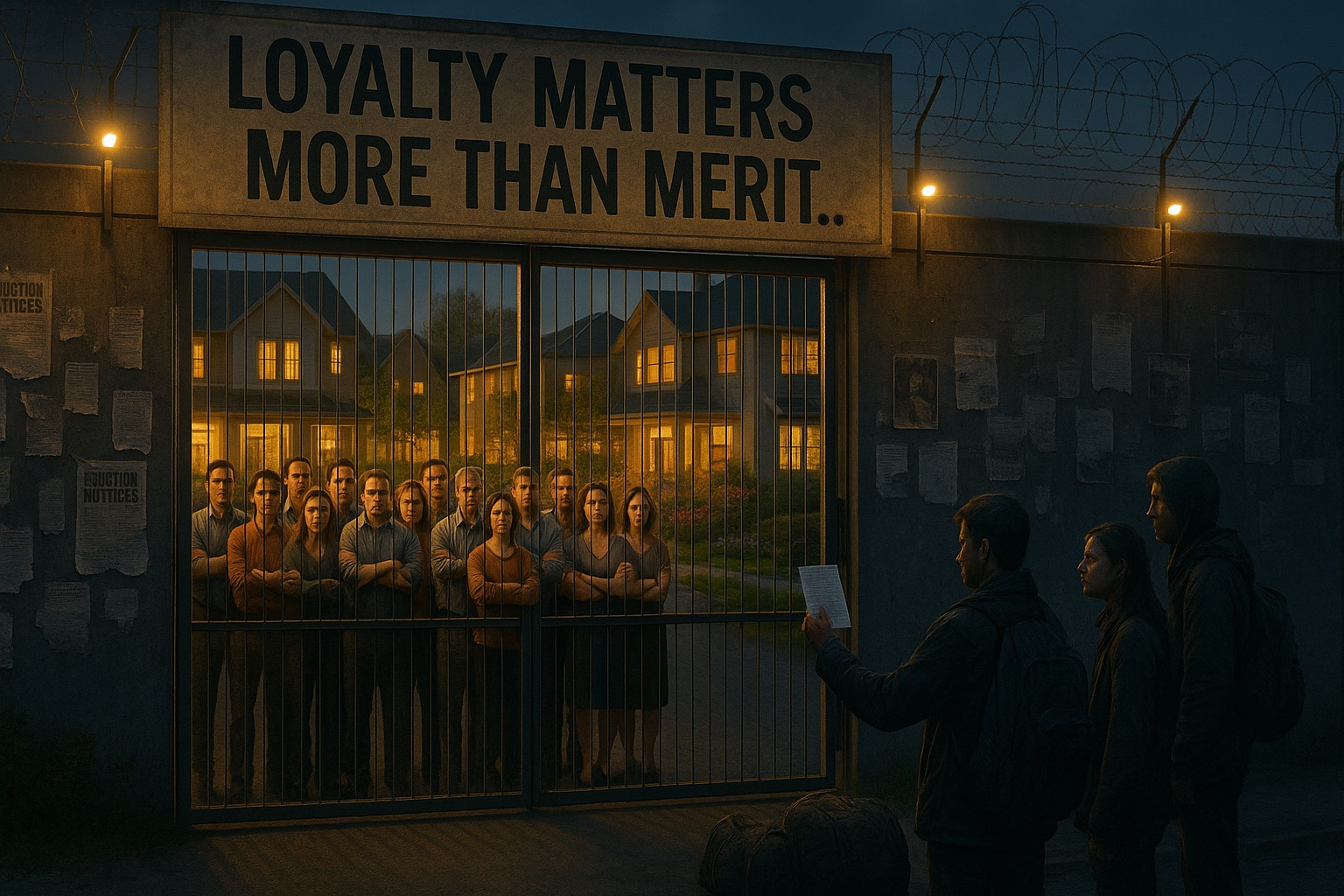
Every community begins as a safety net. Too many end up as a fortress.
What starts as neighbors helping neighbors, a network of trust and belonging, slowly hardens into an insider’s club. Belonging turns into currency. Favors turn into gates. And the same bonds that keep people safe begin to quietly lock others out.
Community vs. Communitarianism
Healthy communities are built on mutuality. They welcome newcomers, exchange support, and adapt to change. Social capital flows freely.
But social capital accumulates. It consolidates. And when loyalty becomes a condition of access, a community crosses a subtle line into communitarianism.
The difference:
Community: “We look out for each other.”
Communitarianism: “We only look out for each other.”
It wears the same face, but its focus shifts from growth to gatekeeping.
The Social Cost of Closed Doors
When this shift happens, solidarity becomes favoritism:
Job markets where only insiders are mentored or hired.
Schools or co-ops where entry depends on “who you know.”
Industries where opportunities circulate within cliques while equally qualified outsiders never get a chance.
What began as protection becomes social insulation. Talented people are locked out, not for lack of merit, but because they don’t belong to the “right” circle.
Even online, this pattern repeats. Activist groups silence dissent, influencers amplify only their own friends, movements gatekeep who counts as “one of us.”
The result: invisible walls in places that once promised openness.
When Trauma Explains, But Doesn’t Excuse
Communitarianism often grows from pain. Marginalized groups, in particular, close ranks out of survival. History justifies the instinct.
But here’s a hard truth: trauma explains behavior. It doesn’t excuse it.
Pain cannot be a free pass for harm. Left unchecked, trauma can turn from shield to sword:
“We were excluded, so now we decide who gets in.”
“The world didn’t protect us, so we owe nothing to anyone else.”
This isn’t healing. It’s payback. It doesn’t break the system; it repeats it with new gatekeepers.
Integration vs. Insulation
There’s a difference between building strength together and hoarding power.
Integration: using a community’s resources to grow and connect outward. Insulation: building walls that protect insiders while shutting everyone else out.
Every community must ask:
Are we empowering and connecting, or just protecting and excluding?
Are we rewarding loyalty over merit?
Who is missing from the room?
When Belonging Becomes a Bran
In the digital age, “community” has also been commodified. Political tribes, lifestyle brands, and social movements now sell belonging. It looks inclusive but often deepens division: echo chambers, cliques, silencing of dissent.
Belonging becomes transactional. Visibility gets mistaken for value.
A Better Model: Circles, Not Fences
What if communities were built like concentric circles instead of fenced yards?
At the core: shared values, culture, or identity. Around that core: porous edges where dialogue flows, ideas enter, and assumptions are challenged.
The goal isn’t to erase difference. It’s to keep openness alive.
The Test of a Communit
The real test of a community isn’t how fiercely it protects its own.
It’s whether it has the courage to keep the door open.
When fear hardens into walls, we lose the very thing that made the community possible in the first place: trust.
If we want communities that are not just safe but wise, we must resist the velvet rope, and choose openness over exclusion.
3. Specific Data Points & Case Studies to Add
To strengthen the argument and give weight:
Hiring & Insiders: Research from Harvard Business Review shows that up to 70% of jobs are never publicly advertised, with most filled through existing networks. This illustrates how insider networks gate opportunities.
Funding Circles: In 2023, 77% of venture capital in the U.S. went to alumni from just three universities (Stanford, Harvard, MIT). This is communitarianism in action.
Housing/Schools: In many cities, co-op housing boards reject applicants without explanation, leading to accusations of favoritism and closed networks.
Digital Gatekeeping: Studies on social platforms like Instagram and TikTok show algorithmic amplification of existing cliques—influencers promoting their own circle while new voices struggle to break in.
Marginalized Groups Example: Highlight how safe spaces for LGBTQ+ youth originally saved lives, but in some contexts, unspoken hierarchies (race, body image, class) later created exclusion within the very spaces built to include.
Social Media: The Double Standard Faced by Minority Creators in a White-Centered Digital World
Even when creators of color manage to build large, loyal audiences, they are still routinely undervalued by brands. Sponsorship deals, promotional collaborations, and product placements, the lifeblood of the influencer economy, are rarely distributed fairly.
In the age of social media, it is easy to believe that influence is democratic, that with enough followers, engagement, and content, anyone can rise. But beneath the surface of algorithms and aesthetics lies a stubborn truth: not all creators are treated equally. And often, those left out of the digital spotlight are the very ones who shaped the culture being sold back to them.
This is not just about visibility. It is about value. In the United States, where whiteness still defines what is considered universal, safe, and aspirational, creators of color remain systemically disadvantaged, even when their numbers, creativity, or influence match, or exceed, their white counterparts.
1. The Illusion of Meritocracy: Followers Are Not the Full Story
On the surface, platforms like Instagram, TikTok, and YouTube give everyone a voice. But what happens when two creators have the same reach, yet radically different opportunities?
A white content creator can post a video of themselves dancing in their kitchen or casually reviewing a snack and rack up millions of views. The same content, posted by a Black or Brown creator, may struggle to reach a fraction of the same engagement. The difference is not effort, not quality, and not even originality. It is who the algorithm favors, and more importantly, who society subconsciously validates.
Social media algorithms are not neutral. They are trained on data, and data reflects human bias. If white creators have historically received more engagement, the algorithm learns to replicate that pattern. Over time, this creates a self-reinforcing loop where whiteness becomes the default setting for success.
2. Beauty, Bias, and the Aesthetic Gatekeeping
Let us talk about appearance. On platforms where images reign, attractiveness becomes currency. But attractiveness itself is often defined by Eurocentric standards: light skin, slim bodies, straight hair, and Western features.
White creators who align with these standards are often able to build massive followings with little more than their looks and lifestyle. Meanwhile, creators of color are often expected to bring something extra, humor, intellect, talent, activism, just to be seen as equally valuable.
This creates an emotional and economic gap. White creators are rewarded for existing. Marginalized creators are rewarded only when they over-perform.
3. Culture as Commodity: The Appropriation Machine
Ironically, many of the trends that go viral, dances, slang, style, music, originate within Black, Latinx, or other marginalized communities. But when it comes to credit, visibility, and monetization, it is often white creators who benefit most.
We have seen this play out repeatedly, especially on TikTok. A Black creator starts a dance trend, only for it to be picked up and popularized by a white creator who gets invited to talk shows, brand deals, and viral fame. The original is left behind, uncredited, unpaid, and often erased.
Cultural capital flows upward, but the profits rarely trickle down.
4. Brand Bias: Equal Followers, Unequal Pay
Even when creators of color manage to build large, loyal audiences, they are still routinely undervalued by brands. Sponsorship deals, promotional collaborations, and product placements, the lifeblood of the influencer economy, are rarely distributed fairly.
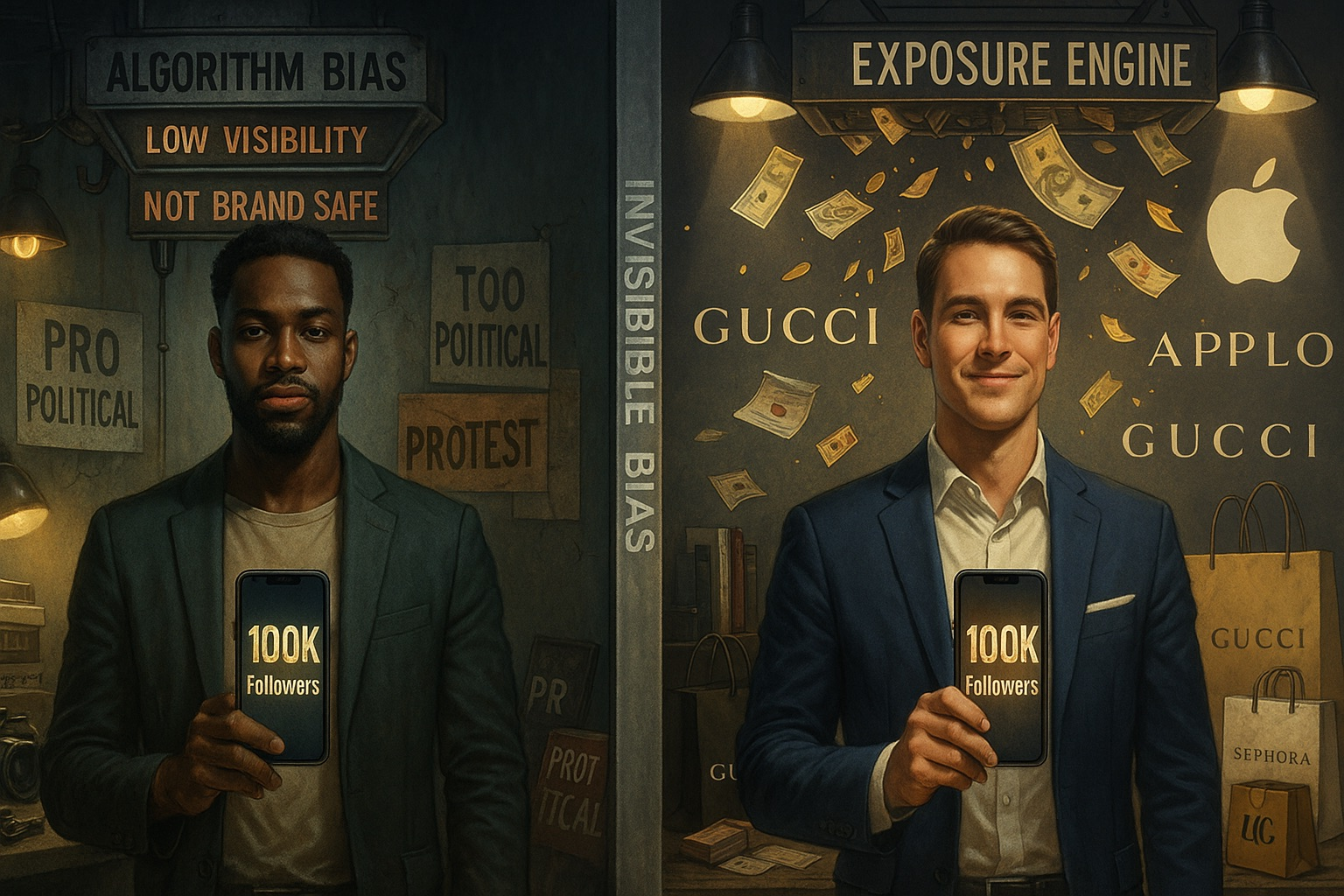
Why? Because brands do not just buy reach. They buy image. And when the people holding the marketing budgets are predominantly white, their choices reflect their comfort zones. This often means defaulting to creators who look like them or who feel “brand safe.”
“Brand safe” is a loaded phrase. It often translates to creators who will not talk about race, politics, or identity. It means appealing to a wide, often white, demographic. It means being palatable, non-threatening, and easy to market.
As a result, a white influencer with 100,000 followers might land a $10,000 brand deal. A Black influencer with the same stats might be offered half that amount, or passed over entirely. And when creators of color push back on these disparities, they are told they are being difficult, demanding, or unprofessional. Meanwhile, brands continue to profit from the culture without investing in the people who create it.
5. The Trap of “Universal Appeal”
There is another trap built into the system: the myth of universal appeal.
White creators are seen as relatable to “everyone.” Their content is considered broadly marketable. But creators from minority backgrounds are often treated as niche, even when their reach spans multiple demographics.
This means that minorities have to translate themselves to be seen. Whether it is switching languages, softening cultural references, or diluting their voice, they are pressured to flatten their identities to fit the mold of what brands and platforms deem accessible.
Meanwhile, white creators do not have to explain themselves, because their culture is seen as the default.
6. The Policing of Cultural Spaces: Damned If You Do…
Perhaps the most ironic injustice is what happens when minority creators finally choose to speak directly to their own communities, creating content that centers Black, Brown, or Asian experiences without catering to a white gaze.
Instead of being celebrated for cultural pride or autonomy, they are often accused of exclusion, division, reverse racism, or “communitarianism.” In short, minority creators are punished for doing exactly what white creators have always done, speak to their own audience, in their own language, from their own reality.
This discomfort often manifests in content being flagged, shadowbanned, or suppressed. It also shows up in comments and brand silence. Why? Because white audiences, and the systems built around them, are not used to being outside the message.
This creates a lose-lose situation. If minority creators code-switch or water down their message, they lose authenticity. If they remain rooted in their community, they are seen as alienating.
7. Algorithmic Censorship and Suppression
Let us be even more direct. The system is designed to reward whiteness and discipline everyone else.
There have been numerous reports and leaked documents showing that platforms like TikTok, Instagram, and Facebook have suppressed content related to Black Lives Matter, Indigenous land rights, police brutality, and LGBTQ+ issues.
Often, the excuse is “violating community guidelines,” even when the content in question contains no hate, nudity, or violence, just truth.
This disproportionate censorship not only limits reach, it forces creators of color into silence or self-censorship just to maintain their accounts or avoid being shadowbanned. Meanwhile, white creators can freely co-opt those same aesthetics or narratives, stripped of context, and be rewarded for “edginess” or “activism.”
So What Is the Solution?
The goal is not to flip the script and disadvantage white creators. It is to expose the imbalance and build systems that reward value more equitably.
That includes transparent brand deals and public pay disclosures. It means algorithm audits to ensure racial and cultural bias is not baked into promotion patterns. It means hiring diverse decision-makers on brand and platform teams. It means direct investment in underrepresented creators, not just through “Black History Month” campaigns or temporary spotlights, but long-term equity strategies.
Most importantly, it means public awareness among audiences. Who we follow, share, and uplift sends a message to the system.
Final Words: It Is Not About Likes. It Is About Liberation.
To be a minority creator in the United States today is to constantly walk a tightrope: be visible, but not too ethnic. Be proud, but not divisive. Be talented, but not threatening. Be everything, and somehow still not enough.
This is not a failure of individual creators. It is a reflection of the systems they are forced to operate within, systems built on legacy ideas about who deserves power, attention, and reward.
But creators are waking up. They are organizing, speaking out, and building their own ecosystems. Because the truth is, culture has always come from the margins.
What is changing now is the demand that credit, compensation, and control follow that culture home.
Until then, the follower count will remain a façade, one that hides the real imbalance behind the screen.
In a world that prides itself on freedom, meritocracy, and equality of opportunity, a troubling pattern persists, one that is so deeply normalized it often escapes scrutiny. Black success, particularly in the United States, is rarely recognized across the full spectrum of possibility. Instead, it is frequently funneled into narrowly defined lanes: sports, entertainment, and spectacle.
And while these spaces can offer wealth and visibility, they also mask a deeper truth, that the freedom of choice available to Black individuals is often shaped by systemic limitation, not genuine equality. This article is not an indictment of sports or entertainment, nor of the remarkable Black individuals who excel in these domains. It is a call to examine why these are the arenas society consistently allows Black talent to thrive in, and what that says about the structure of opportunity itself.
When the Scoreboard Becomes the Only Honest Judge
At first glance, a young Black athlete choosing to pursue basketball, football, or track might appear to be exercising freedom, a self-determined path toward success. And on the surface, they are. But beneath that surface lies a sobering question:
why do so many Black youths choose these specific paths? Is it because they are uniquely gifted in physical ability? Or is it because, historically, these are the only fields where their success cannot be denied, blocked, or rewritten by bias?
When a young Black student excels in sports, the scoreboard does not lie. The stopwatch does not discriminate. A touchdown cannot be subjectively downgraded, and a three-pointer is worth three points regardless of who shoots it. In a society where Black intelligence has been questioned, Black ambition minimized, and Black leadership undermined, the world of sports represents a space where performance is visible, undeniable, and profitable.
The Invisible Gates of Academia and the Workplace
In contrast, academia and corporate spaces operate with invisible gatekeepers. These environments are shaped by recommendation letters, standardized tests, subjective evaluations, “culture fit,” and coded language that often masks racial bias.
In these arenas, success is not just earned, it must also be granted. And historically, Black students have found these gates far more difficult to open. Even in the rare moments when Black professionals break into corporate boardrooms or executive roles, their presence is often viewed through a distorted lens.
Diversity, Equity, and Inclusion initiatives, while created with good intentions, have unintentionally reinforced a damaging perception: that Black individuals are granted access, not earned it. As a result, many are seen as having entered through the service door, as though their positions are charity rather than merit. This undermines the fact that many of these individuals are not only qualified, but overqualified, often having had to work twice as hard to prove their worth in systems that were never designed for them to thrive in.
Education as a Barrier Disguised as Opportunity
Beyond that, tuition itself has become a class weapon. For individuals with equal potential, access to elite education is no longer about intellect, but income. The rising cost of college has become a strategic barrier, filtering out entire demographics under the guise of meritocracy. It is a quiet but powerful method of exclusion, one that keeps “undesirable” populations out without ever having to name race or class directly. Opportunity is sold at a price few can afford, and the illusion of fairness is preserved by pointing to the few who manage to break through.
Why Sports Remain a Refuge of Recognition
This is precisely why sports have remained so deeply rooted in Black families as a vehicle for advancement. On the field, merit is visible. Performance is measured in real time. Talent is undeniable. In sports, success is harder to distort, harder to question, and less likely to be explained away as a favor. When a Black athlete wins, the world sees it. It’s not up for debate. There are no hidden criteria, no back doors, no whispers of diversity quotas, just skill, will, and result. For many Black families, that visibility is worth everything.
Survival Through Strategy, Not Passion Alone
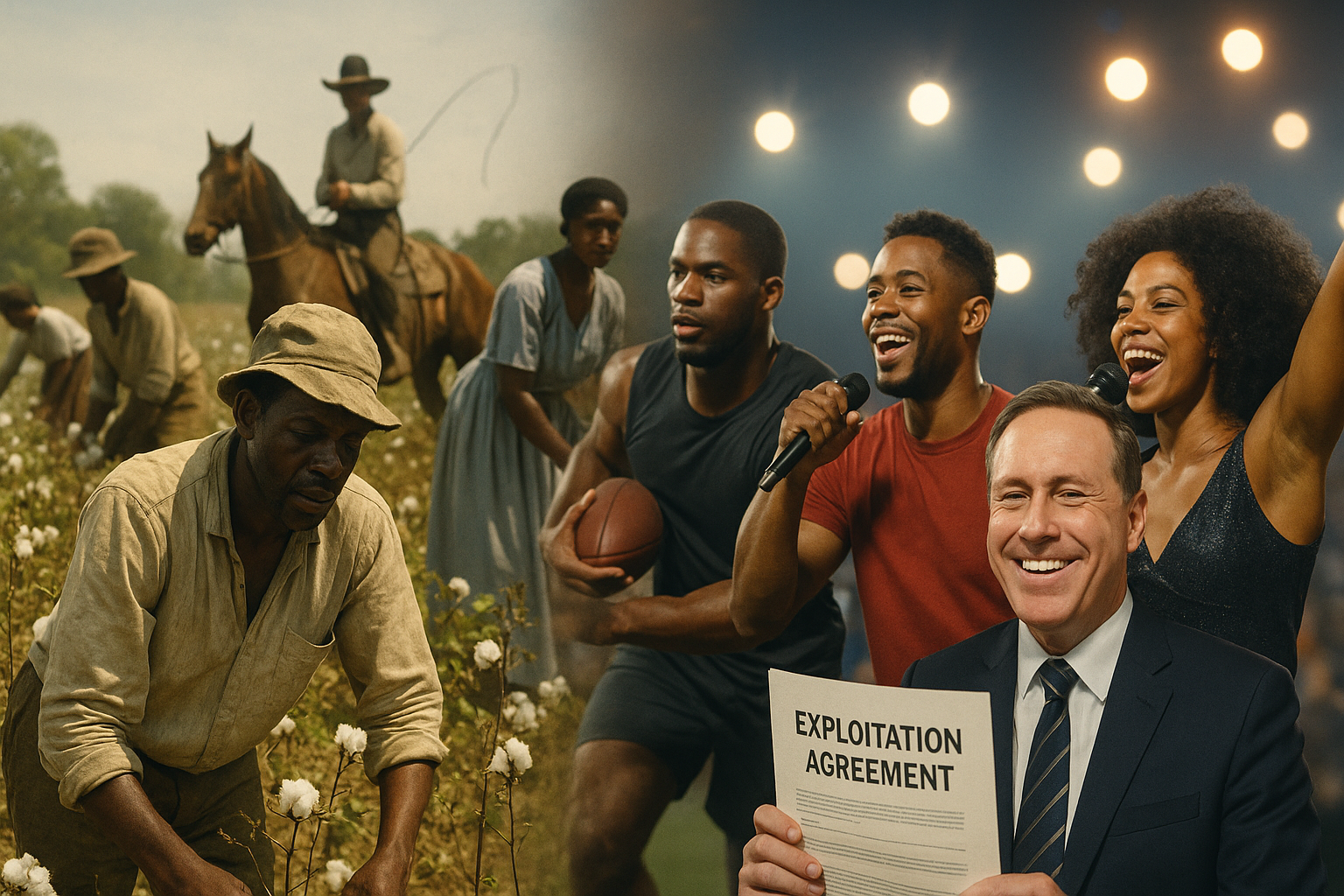
Given this landscape, is it really freedom of choice when a Black teenager chooses to pour themselves into athletics, where success is measured in points, not permission? The pursuit of sports is not just passion. It is strategy. It is survival. It is the conscious or unconscious gravitation toward a realm where their excellence will not be hidden or diminished. Black athletes today are not enslaved in the literal sense. They sign contracts, negotiate salaries, and own businesses. But that does not mean the systems around them are free of exploitative dynamics. When sports institutions, media companies, and sponsors earn billions off the physical labor and public image of Black athletes while maintaining white leadership at every institutional level, the echoes of exploitation become hard to ignore. This becomes especially apparent in college athletics, where the overwhelming majority of players in high-revenue sports like football and basketball are Black, while coaches, athletic directors, and university presidents remain predominantly white. The system profits off Black labor while preserving white power, and calls it education. In the professional arena, Black athletes are celebrated when they entertain, but often punished or silenced when they speak out. Their success is welcomed as long as it doesn’t threaten the structures that benefit from their visibility.
Excellence Repackaged as Instinct
Black people are still used for their physical capacity to sustain effort, echoing the exploitative slavery system. Their achievements are too often framed through tropes such as “natural talent” instead of “hard work,” while their white counterparts are more often praised for “cerebral intelligence.” The language alone reveals a hierarchy in how success is interpreted. Brilliance in a Black body is seen as instinct, not discipline. Intelligence in a white body is seen as earned.
Ask yourself: Why aren’t there more Black physicists on magazine covers? Why aren’t there more Black venture capitalists featured on business panels? Why aren’t there more Black CEOs of tech giants, law firms, or biotech firms?
The talent is there. The drive is there. But the gates are still closed or guarded. The media rarely spotlights Black excellence in these areas, even when it exists. It simply doesn’t fit the narrative society is used to consuming.
Entertainment as Containment
Meanwhile, a single Black NBA player or rapper garners more attention than an entire generation of Black scholars. Not because they matter more, but because these are the forms of Blackness society finds easiest to consume.
What happens when a group is only celebrated in roles that entertain others? What message does it send when Black bodies are on every screen but rarely at the table of real decision-making?
It creates a form of cultural containment. You are allowed to thrive, as long as you stay in the role that’s been scripted for you. And so, from a young age, Black children look to entertainers and athletes for aspiration. Not because they lack dreams of being doctors, engineers, or scientists, but because they see who gets celebrated. They see whose success gets televised, whose face ends up on a sneaker, and who gets silenced when they speak truth. This is not a coincidence. It is design.
A Curated Illusion of Equality
It’s not that Black people cannot succeed elsewhere, they do. Quietly. Brilliantly. Relentlessly. But the question is: where is that excellence systemically supported, publicly acknowledged, and culturally amplified? Too often, it is only in sports and entertainment. That is not freedom. That is a curated illusion of opportunity. Understanding this truth does not mean devaluing the incredible achievements of Black athletes and entertainers. Their contributions are immense, worthy, and culturally transformative. But it does mean recognizing that their dominance in these fields is not just about talent, it’s also about constraint. It’s about a system that, through centuries of exclusion, has left fewer open doors, and then celebrates those who walk through the few that remain.
A Call for Real Equity
If we want a truly equal society, we must do more than praise Black success on the field. We must ask:
what would happen if we supported Black potential in every domain with the same intensity, visibility, and investment? What if we cared as much about the next Black philosopher as we do about the next NBA draft pick? What if we funded schools the way we fund stadiums? What if we taught every Black child that their worth is not determined by applause, but by their unshakable right to thrive in any arena they choose?
The path to truth may be complex, but the insight is clear. Black people are not limited by talent. They are limited by the spaces that society chooses to reward them in. And when excellence is only accepted in roles that entertain, that is not progress, it’s a more polished form of containment. It’s time to ask not just why Black people choose sports, but why society keeps choosing to only reward their greatness when it’s on display, not when it’s in defiance. Until we expand the definition of what Black excellence looks like, we are not living in a meritocracy, we are just watching a game, and calling it freedom.