Jailed for Profit: How Private Incarceration Turned Justice into Revenue
Mass arrests remove taxpayers, reducing IRS revenue, and require the government to lease additional detention beds, costs that taxpayers end up paying on top of the expenses for existing beds.
Inside the daily-rate economy that thrives on human confinement.
“When Irena Green went to jail for brown grass, and Pennsylvania judges Mark Ciavarella and Michael Conahan pocketed millions to fill cells with children as young as 11, we glimpse a darker truth: in America, incarceration isn’t merely punishment; it’s profit.”
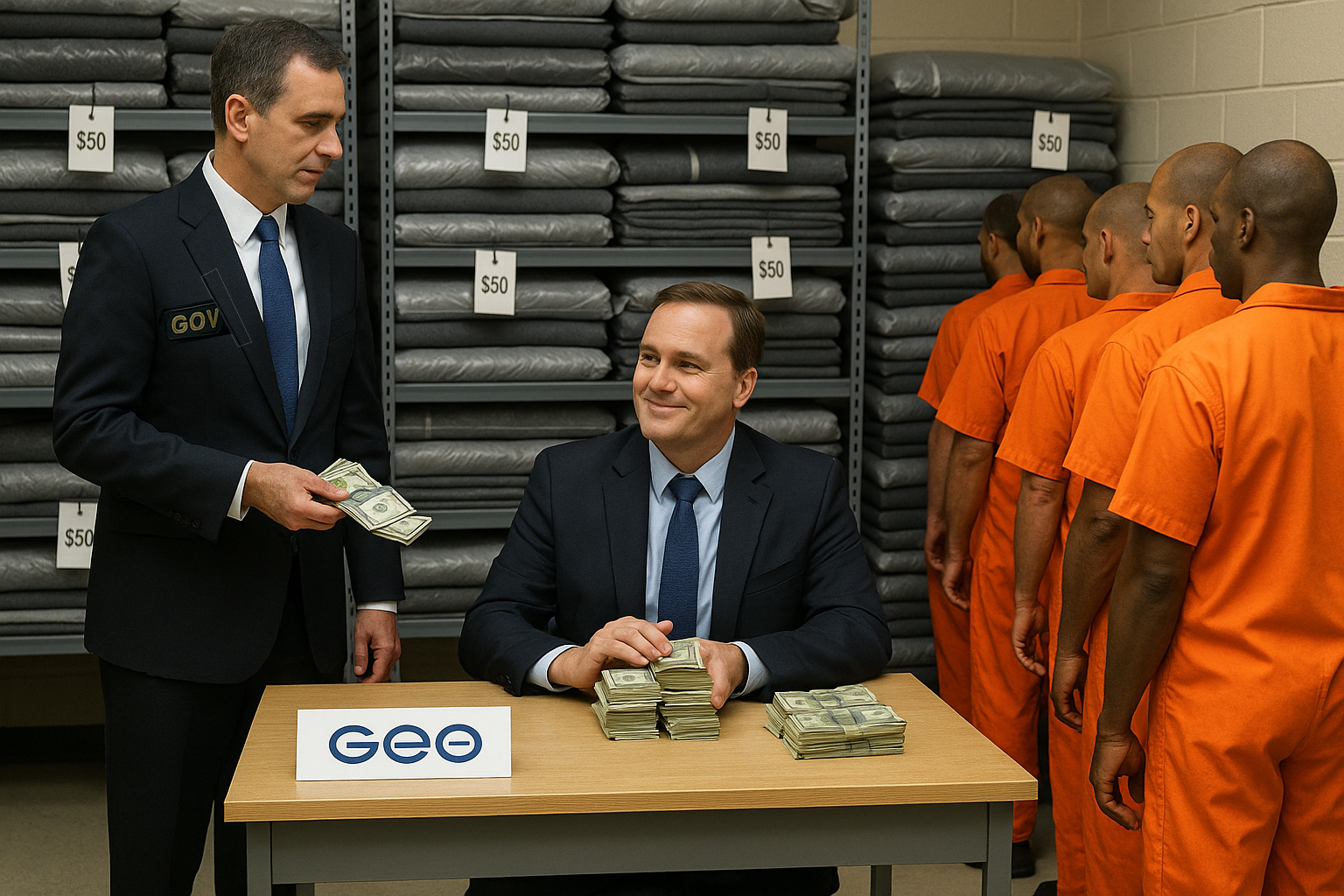
The rise of private incarceration in the United States has transformed detention from a public responsibility into a lucrative enterprise. Companies like The GEO Group and CoreCivic have perfected a model that monetizes human confinement, billing governments by the day for each occupied bed. This system turns jail cells into revenue streams and sentencing into supply-chain management.
THE PRIVATE-PRISON BUSINESS MODEL
At the heart of this carceral economy is the daily-rate deal:
Daily-Rate Billing: Governments pay private operators a fixed rate for each detainee per day, often at prices that rival or exceed comparable public facilities.
Guaranteed Bed-Filling Clauses: Contracts commonly include “lock-in” provisions guaranteeing payment for 80–100% of design capacity, even if beds remain empty.
Rapid Expansion, Limited Oversight: Facing overcrowding, agencies outsource construction and management to private firms, trading transparency and public oversight for off-balance-sheet convenience.
Each inmate becomes a living invoice. When beds translate directly into dollars, incentives shift: shrinking incarceration rates threaten corporate profits.
A MARKET BUILT ON CONFINEMENT
The financial logic is chilling:
In May 2005, ICE terminated GEO’s contract after discovering GEO was charging \$225 per day, over four times the \$53 per-day public-sector average (AFSCME Affiliate Staff Portal).
Private facilities typically bill between \$50–\$90 per inmate per day, embedding healthy profit margins under the guise of comparable costs (Corte IDH).
Guaranteed-occupancy clauses enforce a “take-or-pay” structure, ensuring revenue even when crime rates fall.
Implication: To sustain profitability, these companies benefit from policies that inflate arrests, extend sentences, and amplify detentions, be it through stricter immigration enforcement or punitive sentencing laws.
A CARCERAL ECOSYSTEM, NOT JUST PRISONS
Private-prison operators have vertically integrated across the detention lifecycle:
Rehabilitation & Reentry Under programs like “GEO Continuum of Care®,” companies sell education, therapy, and vocational training, often for additional fees.
Electronic Monitoring GPS ankle bracelets and “house arrest” programs convert private homes into pay-per-day detention sites.
Mental-Health & Juvenile Facilities Firms now run secure psychiatric centers, mimicking prison per-diem structures that guarantee Big Pharma both a captive patient base and a lucrative partnership to push medications.
Global Partnerships Public-private contracts span federal, state, and international agencies, blurring lines between government oversight and corporate control.
This network creates an ecosystem engineered to perpetuate its own growth, ensuring persistent demand for beds, physical or virtual.
CASE STUDY: ALLIGATOR ALCATRAZ
In July 2025, Florida unveiled “Alligator Alcatraz,” a 5,000-bed emergency camp in the Everglades:
Emergency Procurement: Governor DeSantis declared a “state of emergency,” fast-tracking contracts and sidestepping standard competitive bids and environmental reviews.
\$245 Million in Contracts: Within 30 days, private firms secured massive per-diem and service agreements, collecting daily fees without assuming real-estate risk.
Contractor Windfalls: Security, logistics, and construction companies with political ties profited handsomely, proving that crisis breeds cash flow.
Surrounded by swamp and razor wire, Alligator Alcatraz stands as a stark emblem of carceral capitalism thriving under the guise of crisis response.
THE MORAL COLLAPSE OF PROFITABLE PUNISHMENT
When imprisonment is a business, justice unravels:
Judicial Corruption: Between 2003 and 2008, Judges Ciavarella and Conahan accepted kickbacks to send over 2,500 children to for-profit juvenile facilities, often for minor infractions, lining private pockets at the expense of young lives .
Eroded Government Control: Guaranteed-occupancy clauses tie policymakers’ hands, effectively outsourcing sentencing and penal policy.
Criminalizing the Mundane: In Hillsborough County, Florida, Irena Green spent seven days in jail, for brown grass and a dirty mailbox, after her HOA escalated property-covenant violations into contempt charges (People.com, ABC Action News Tampa Bay (WFTS)).
In one recent Florida case, homeowner Irena Green spent seven days in jail for HOA violations, brown grass and a dirty mailbox. Though she complied with cleanup orders and sold her van to pay fines, she missed a court notice and was jailed for contempt. Her case, covered by Fox 4, People, and AOL, illustrates how even the mundane can become criminalized when systems are wired for extraction.
THE PHARMA-PRISON NEXUS
One of the most insidious expansions of profitable punishment is the integration of the pharmaceutical industry into the incarceration machine. As private operators moved into juvenile and mental health facilities, they imported a profit model that treats behavioral disorders as billing opportunities.
Psychotropic Medication as Revenue: In private youth detention and psychiatric centers, diagnoses of ADHD, depression, and bipolar disorder are disproportionately high. Medications are administered not always as treatment, but as behavior control, each prescription subsidized by Medicaid or state contracts.
Lobbying and Legislation: In 2024, lobbying expenditures by the pharmaceutical industry exceeded $400 million, more than defense contractors and oil combined. Among their targets: mental health legislation tied to juvenile justice reform. Bills that increase state reimbursements for mental health “treatment” in carceral settings were quietly supported by both prison companies and pharma giants.
Captive Market Exploitation: Detained individuals, especially juveniles, lack the ability to consent freely, challenge diagnoses, or refuse medication. The result: a system where diagnosis becomes diagnosis-for-profit.
This collaboration rewards over-medication and undermines public health. It’s not about healing, it’s about harnessing bodies for perpetual billing.
THE COST OF FALSE ECONOMY
Some political parties and policymakers argue that private prisons save money, but that claim collapses under scrutiny
Undocumented immigrants, for example, paid $96.7 billion in federal, state, and local taxes in 2022, averaging $8,889 per person, yet remain barred from receiving many benefits they help fund.
Mass arrests remove these taxpayers from the workforce, eroding IRS revenue, and force new leasing of detention beds, effectively transferring funds from public coffers to private contractor profits. In effect, In effect, the money “saved” by denying benefits is funneled into private incarceration firms billing per head, per day.
PUBLIC SAFETY OR PRIVATE PROFIT?
The rise of for-profit detention, from mental health facilities to migrant camps to digital monitoring, reveals not just a broken justice system, but a profitable one. One engineered to expand, not to resolve. A system where taxpayers foot the bill, private companies cash the check, and human lives are reduced to recurring revenue.
This isn’t just an economic failure. It’s a moral collapse.
When we tether justice to profit, cruelty becomes cost-effective. Judges become suppliers. Prison beds become quotas. And the law itself bends to serve the balance sheet.
We are not arguing for an end to incarceration. But we must end the monetization of it.
Because so long as punishment remains profitable, justice will remain compromised, and freedom, for sale.
The question is no longer whether we can afford to end private detention, but whether we can afford the moral cost of keeping it.
In an era of global mobility, dual citizenship has become increasingly common. Millions of Americans hold more than one nationality for reasons that range from family heritage to professional opportunity. For private citizens, this status presents little legal or ethical difficulty. The debate becomes more complex, however, when dual nationals occupy positions of sovereign authority, particularly in roles involving national security, judicial power, public procurement, or executive command.
In democratic systems, public confidence is shaped not only by legal compliance but by perception. When authority appears visibly concentrated within a shared demographic or affiliation, segments of the public may speculate about influence, regardless of which identity group is involved. Such reactions are not unique to any one society; they recur across political systems whenever power and pattern intersect.
Against that backdrop, when an individual holds allegiance to two sovereign states while exercising authority on behalf of one of them, legitimate structural questions arise regarding conflicts of interest, divided loyalty, and vulnerability to foreign influence. Risk management at the level of national governance is not about presuming guilt. It is about minimizing exposure.
This keeps the argument institutional, avoids singling out any group, and strengthens the logical bridge between perception and structural safeguards.
Allegiance and Constitutional Duty
Public office in the United States requires an oath to support and defend the Constitution. That oath establishes legal primacy. Dual citizenship does not automatically negate that obligation. However, it introduces structural duality.
A dual national may be subject, at least in theory, to competing legal frameworks, tax regimes, military obligations, or political pressures. Even if no actual conflict exists, the appearance of divided allegiance can erode public trust. In governance, perception is not cosmetic. It is foundational.
This concern intensifies in positions such as:
The President and executive cabinet members
Federal judges, including Supreme Court justices
Department of Justice officials
Members of Congress
Senior intelligence and defense officials
These roles involve access to classified information, prosecutorial discretion, treaty negotiation, and strategic military decisions. The higher the authority, the higher the insulation threshold should be.
The Constitution does not prohibit dual citizens from holding most federal offices. Any categorical ban would likely face strict scrutiny under Equal Protection principles. Therefore, the question is not exclusion. It is calibration.
Structural Vulnerabilities
Dual nationality may create exposure in three principal areas:
1. Information Security
Access to classified intelligence increases leverage potential. Foreign states exert influence not only through ideology, but through law, assets, family jurisdiction, and diplomatic channels. Even absent disloyalty, structural exposure exists.
2. Procurement and Financial Influence
Government contracts allocate enormous public resources. Even transparent decisions may invite scrutiny if ties to a secondary sovereign jurisdiction exist. Structural safeguards are stronger than reactive investigations.
3. Jurisdictional Complexity
Dual nationality can complicate accountability in rare but significant cases. Extradition between allied nations exists, including treaty arrangements between the United States and Israel. However, extradition is a diplomatic and judicial process, not an automatic administrative procedure.
Israel’s Law of Return, for example, provides a pathway to citizenship for eligible individuals. While cooperation between the United States and Israel does occur under bilateral extradition agreements, cross-border legal frameworks inherently introduce procedural complexity. These examples do not demonstrate systemic evasion, nor do they imply collective misconduct. They illustrate how dual sovereignty can complicate jurisdiction in high-stakes cases.
Structural exposure does not equal wrongdoing. It equals vulnerability.
Institutional Trust and High-Profile Failures
Public distrust in elite institutions intensified following the prosecution and death of convicted child sex offender and sex trafficker, Jeffrey Epstein. His case revealed documented breakdowns:
Surveillance cameras malfunctioned.
Jail guards failed to perform required checks.
A prior non-prosecution agreement shielded him from federal charges for years.
The official autopsy conclusions were publicly contested by independent forensic experts.
Public controversy emerged regarding the release and provenance of certain post-mortem images.
These irregularities intensified skepticism about elite accountability and institutional transparency.
No verified evidence demonstrates that dual nationality played any role in those failures. However, when institutional credibility is already fragile, structural ambiguities surrounding allegiance become amplified in the public imagination.
Is Epstein really dead, or did he exploit Israel’s Law of Return loophole and receive protection abroad?
There is no evidence supporting such a scenario. Yet the persistence of that question illustrates how profoundly trust has eroded. When oversight mechanisms fail visibly, alternative explanations, however speculative, gain traction.
Israel’s Law of Return provides a legal pathway to citizenship for eligible individuals. In past cases unrelated to Epstein, certain U.S. criminal defendants accused of sexual offenses have relocated abroad, including to Israel, while legal U.S proceedings were pending, prompting complex extradition negotiations. Organizations such as Jewish Community Watch have publicly tracked cases involving alleged offenders who left the United States and resettled overseas.
These cases do not establish systemic evasion, nor do they implicate any community collectively. They do, however, demonstrate how cross-border citizenship frameworks can complicate jurisdictional accountability.
When governance structures appear opaque or compromised, speculation expands to fill the gap.
In democratic systems, legitimacy depends not only on actual impartiality, but on visible insulation from foreign influence.
Public Confidence and Symbolism
Government is not merely functional; it is symbolic. When officials represent domestic interests, they embody national sovereignty. Visible clarity of allegiance reinforces institutional legitimacy.
The concern is not cultural pride. It is mandate clarity. When adjudicating constitutional rights, directing federal investigations, or negotiating foreign policy, the official should be unambiguously perceived as representing only one sovereign authority, or structurally safeguarded against conflicting exposure.
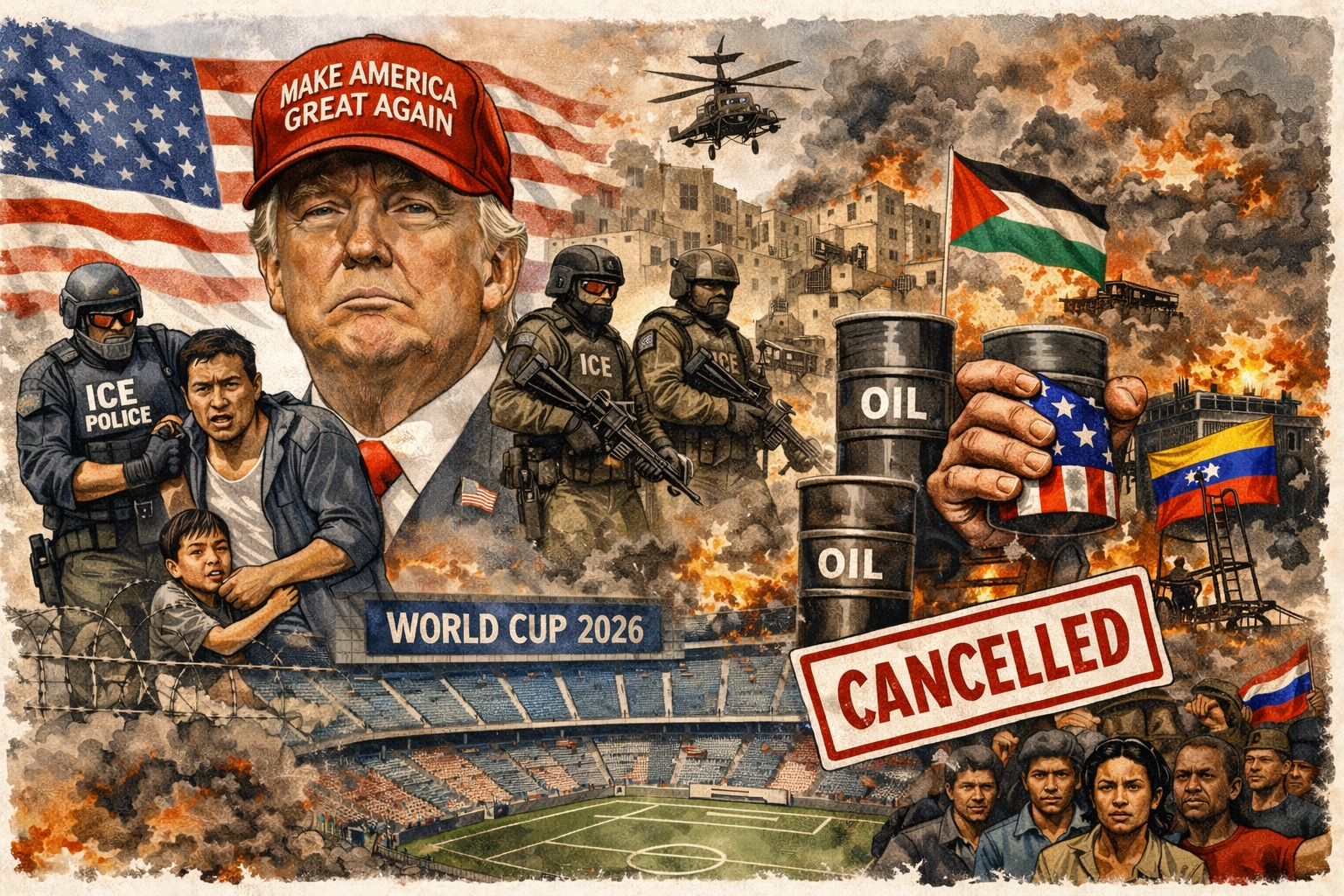
“Make America Great Again” is not a slogan. It is an operating system.
It does not merely gesture toward nostalgia; it reorganizes power. It decides whose bodies are protected by law and whose are exposed to it. It determines which rules are sacred, which are flexible, and which are suspended entirely. Under its logic, legality becomes a costume worn by force, and greatness becomes synonymous with control.
What MAGA ultimately represents is not hypocrisy. It is imitation. The United States has begun to practice the very techniques it condemns abroad: racialized enforcement, selective legality, collective punishment, resource extraction wrapped in moral language, and spectacle deployed to obscure structural decay. This is not an accident of excess. It is a system functioning as designed.
And no event exposes this contradiction more brutally than the 2026 FIFA World Cup, a global celebration now colliding with a state that has turned exclusion into identity and enforcement into theater.
The Trump era did not invent this architecture. But it normalized it, accelerated it, and stripped it of shame. What remains is not a deviation but a durable regime logic embedded in institutions, courts, and incentives. The question is no longer whether the United States is powerful. The question is what kind of power it now exercises, and against whom.
The Internal Border
Begin at home.
Under the banner of restored sovereignty, immigration enforcement was transformed from administrative function into domestic occupation strategy. Immigration and Customs Enforcement ceased to operate as a regulatory agency and became a roaming shock force. Interior raids, courthouse arrests, workplace sweeps, and expedited removals were not excesses. They were policy.
No new laws were required. Old statutes were weaponized. Discretion was narrowed. Detention was expanded. Migrants were redefined not as civilians under the law but as permanent suspects. The outcome was not random. Enforcement clustered around phenotype, geography, and economic vulnerability with mechanical precision. Black and Latino communities were targeted not because the law named them, but because the system moved where resistance was weakest and visibility was highest.
Courts did not stop this logic. They merely managed its tempo.
In Department of Homeland Security v. Regents of the University of California, the Supreme Court blocked the rescission of DACA not because it was cruel, but because it was sloppy, affirming that cruelty still required paperwork. In Nielsen v. Preap, the Court expanded mandatory detention, collapsing time, context, and proportionality into a single axis of confinement. In East Bay Sanctuary Covenant v. Trump, federal judges struck down asylum bans that violated statute, again confirming the pattern: the executive would push until physically restrained.
Law did not constrain power. It chased it, always one step behind, always legitimizing the terrain already lost.
What distinguishes this moment is not that enforcement occurred, but how it was framed. Law became theater. Due process became optional. Disparate impact was dismissed as coincidence. An internal border emerged, not at the nation’s edge, but inside its cities, workplaces, and courts.
For millions of residents, the state no longer appeared as guarantor of rights but as an unpredictable, punitive presence, racialized, roaming, and unaccountable.
That is not security. That is authoritarian practice with democratic aesthetics.
Selective Law Abroad
The same logic governs U.S. behavior beyond its borders.
The United States condemns annexation, collective punishment, and civilian harm when practiced by adversaries, and rationalizes them when practiced by allies. This is not inconsistency. It is hierarchy.
Nowhere is this clearer than in unwavering U.S. support for Israeli territorial expansion and military campaigns despite persistent findings of international law violations. Settlement construction in occupied territory violates the Fourth Geneva Convention. Civilian harm in Gaza has repeatedly triggered alarms from humanitarian organizations. Yet U.S. policy has functioned as a shield: diplomatic cover, weapons transfers, and Security Council vetoes deployed reflexively.
International law, in practice, applies downward.
Who is protected is not determined by legal principle, but by alignment. Accountability is reserved for enemies. Allies are granted impunity. This is not the erosion of a rules-based order. It is its exposure.
Modernized Colonialism
Venezuela completes the triangle.
The Trump administration’s sanctions regime was openly designed to strangle oil revenue, a fact acknowledged in Treasury statements and litigation records. Recognition of an alternative president, asset seizures, and economic isolation were justified as democracy promotion and counter-narcotics. But the throughline was unmistakable: leverage over resources.
The humanitarian consequences, economic collapse, civilian suffering, institutional breakdown, were not unfortunate side effects. They were predictable outcomes. Sovereignty became conditional. Legality became negotiable. Extraction became moral so long as it was narrated correctly.
This was not a return to colonialism. It was colonialism updated for the age of compliance language.
One System, One Logic
Together, ICE enforcement at home, selective legality abroad, and resource-driven coercion, the pattern is unmistakable.
Power flows downward. Accountability dissolves upward. Law becomes vocabulary for force rather than a limit on it.
This is precisely the behavior the United States claims to oppose when it condemns authoritarian regimes elsewhere. The imitation is not partial. It is exact.
Predictably, the world noticed.
Pew Research Center surveys during and after the Trump presidency recorded historic declines in favorable views of the United States across Europe, Latin America, and Africa. The language hardened. Racism. Authoritarianism. Fascism. These terms entered mainstream discourse not as academic diagnoses but as lived judgments.
Reputation does not require consensus. It requires repetition.
The World Cup Collision
This reputational collapse is not abstract. It converges violently with the politics of spectacle.
The 2026 FIFA World Cup is not a neutral sporting event. It is a stress test.
Mega-events operate on trust, the assumption that visitors will be welcomed, processed, and celebrated rather than scrutinized, delayed, or humiliated. Host nations rely on goodwill as infrastructure.
The United States is uniquely exposed. Soccer’s global audience is overwhelmingly non-white, non-Western, and working class. It is concentrated in regions and communities that have borne the brunt of U.S. immigration enforcement, sanctions regimes, and military interventions.
Add law to the equation.
In Trump v. Hawaii, the Supreme Court upheld the travel ban affecting several Muslim-majority countries, affirming near-total executive discretion over entry under the guise of national security. The ban was later rescinded. The precedent was not.
For prospective fans, the calculation is rational. High ticket prices. Uncertain visas. Invasive screening. A political climate that frames them as suspects. This is not an invitation. It is a warning.
FIFA has worsened the problem by setting record-high ticket prices, excluding the sport’s core supporters. When alienation intersects with affordability, disengagement is not protest. It is inevitability. Stadiums may fill with sponsors, but atmospheres will be hollow.
Extracted Unity
Inside the United States, the contradiction sharpens.
Communities disproportionately targeted by ICE are asked to perform national unity in a spectacle that symbolizes openness. This is not irony. It is legitimacy extraction. The state demands celebration from those it polices most aggressively. It demands loyalty from those it renders precarious.
That demand reveals the moral core of the project.
What “Greatness” Meant
“Make America Great Again” promised restoration. But restoration of what?
Dominance without accountability. Borders without humanity. Law without justice.
Greatness was redefined as control. Integration became weakness. Multilateralism became surrender. This was not rhetorical excess. It was a governing logic.
Political systems that define themselves through enemies require enemies to function. Migrants, protesters, foreign governments, international institutions, interchangeable targets in a permanent mobilization against threat. Authority is asserted through exclusion. Legitimacy is claimed through force. Dissent is reframed as danger.
This is how authoritarian systems stabilize, not through ideology alone, but through daily practice.
The Bill Comes Due
The World Cup exposes this because soccer belongs to the people these systems historically marginalize: the poor, the displaced, the racialized, the global majority. To host it while criminalizing its people is to stage a contradiction too large to brand away.
The choice remains.
Greatness can be redefined as legitimacy earned rather than fear imposed. As law that restrains power rather than decorates it. As openness practiced rather than advertised.
Or the United States can continue mistaking compliance for consent and spectacle for unity.
History does not care about slogans. It records patterns.
And the pattern is now unmistakable: A nation that claims to fight authoritarianism has learned to practice it. A state that preaches rule of law has mastered its selective suspension. A host seeking global celebration has alienated the very world it wants to welcome.
The paradox of “Make America Great Again” is not rhetorical. It is operational.
And the cost, economic, moral, and diplomatic, is no longer theoretical. It is already being charged.
How Financial Institutions Manufacture “Winners” and Trap Wealth at the Top
Finance does not create value, it redirects it. What looks like market success is often capital concentration mistaken for merit. Blue-chip companies are not discovered by markets; they are reinforced by money.
The First Illusion: That Finance Is the Source of Wealth
Let us begin with the strongest version of the opposing argument.
Finance, we are told, creates value by:
Allocating capital efficiently
Pricing risk
Providing liquidity
Accelerating innovation
All of this is functionally true.
And yet it obscures a more fundamental reality.
Finance does not create primary value. It does not generate new goods, new labor, new energy, or new ideas.
What finance creates is movement:
Movement of capital
Movement of risk
Movement of ownership
Movement of claims on future production
Finance is not the engine. It is the transmission.
And a transmission, no matter how sophisticated, cannot move without power already generated elsewhere.
No surplus → no deposits No deposits → no leverage No leverage → no derivatives No derivatives → no exponential returns
This is not a moral critique. It is a mechanical one.
Finance is structurally dependent, not generative.
More precisely: labor creates value once; finance monetizes that value indefinitely through layered claims.
Why Financial Institutions Chase the Wealthy, and Ignore Everyone Else
Because capital is not the product.
It is the raw material.
A financial institution without capital is a refinery without crude oil. This is why banks, asset managers, and funds aggressively court:
Ultra-high-net-worth individuals
Corporate treasuries
Pension systems
Sovereign wealth funds
Retail investors matter only at scale. Large capital holders matter individually.
This reveals the system’s real hierarchy:
Labor sustains the economy. Capital sustains finance.
Which is why finance does not primarily serve workers, consumers, or innovators.
It serves those who already control money.
The wealthy are not clients. They are inputs.
Blue-Chip Companies Are Not “Safe” They Are Selected
“Blue chip” suggests reliability, stability, and merit earned over time.
In practice, blue-chip status is constructed.
Not discovered.
The Selection Loop
A modern blue chip emerges through a predictable and repeatable sequence:
Financial institutions concentrate capital into a firm or sector
Analyst coverage signals legitimacy
Index inclusion forces passive inflows regardless of valuation
Liquidity dominance attracts secondary capital
Cheap debt enables buybacks and acquisitions
Competitors starve, not from inferior ideas, but from inferior access to capital
At this point, performance becomes secondary.
Capital itself predefines success, then retroactively calls it merit.
This is not competition. It is capital-assisted natural selection.
Once a firm becomes systemically owned, its survival becomes politically mandatory. Markets no longer evaluate the company. They protect it, because its failure would expose the fiction of market discipline itself.
Big Tech Was Not Inevitable, It Was Reinforced
Apple, Microsoft, Amazon, and Google are often described as inevitable winners.
They were not.
They were continuously reinforced.
By the early 2020s, the five largest technology firms accounted for over a quarter of the total market capitalization of the S&P 500, forcing trillions of dollars in passive investment to flow into the same names regardless of fundamentals. This was not investor choice. It was index mechanics.
Capital followed structure, not analysis.
The reinforcement mechanisms were clear:
Massive institutional ownership consolidated voting power
Index inclusion created permanent demand
Cheap debt financed endless buybacks
Acquisitions neutralized threats before they matured
Once capital commits at scale, failure becomes unacceptable, not because of innovation, but because collapse would damage:
Pension funds
Index products
Institutional balance sheets
Political legitimacy
At that stage, success is no longer earned.
It is maintained by capital gravity.
Banking Consolidation: When Markets Quietly Exit
Since the 1990s, U.S. banking has collapsed into a handful of megainstitutions.
In 1984, the United States had over 14,000 commercial banks. Today, fewer than 4,200 remain, while the largest institutions control the majority of assets. This was not the result of natural efficiency alone. It was the outcome of policy preference for scale after each crisis.
JPMorgan Chase, Goldman Sachs, and Citigroup did not outcompete the market.
They absorbed it.
After each disruption, the rule remained consistent:
Large institutions are protected. Small institutions are expendable.
Failures were socialized. Mergers were encouraged. Risk was rewarded retroactively.
Competition did not disappear by accident.
It was removed because systemic size became indistinguishable from safety.
The free market did not fail. It was deemed inconvenient.
2008 Was Not a Breakdown, It Was a Stress Test
The 2008 financial crisis is often framed as betrayal.
That framing is comforting. And wrong.
2008 demonstrated that financial institutions could:
Privatize gains
Externalize losses
And survive intact
Trillions of dollars in guarantees, liquidity facilities, and asset purchases, many deployed off balance sheets, ensured that markets were never allowed to clear. Loss was not eliminated. It was redistributed downward.
The system did not collapse.
It proved its priorities.
Bailouts were not generosity. They were the price of dependency.
By concentrating risk at the top, institutions ensured that failure would be catastrophic enough to demand rescue.
This was not capitalism failing.
This was capitalism revealing its power hierarchy.
Derivatives: Profit Without Production
Derivatives are often praised as innovation.
In reality, they are synthetic claims.
They do not create wealth. They redistribute exposure.
Their profitability depends on:
Large capital pools
Stable narratives
Continuous inflows
Crucially, derivatives are frequently written on the same assets institutions promote as “safe.”
This creates a closed loop:
Institutions:
Shape asset narratives
Sell products based on those narratives
Trade volatility they influence
Help shape the regulations governing the market
Creator. Seller. Speculator. Regulator.
No external discipline required.
The Structural Truth: Finance Converts Surplus into Dependency
Finance cannot exist without value created elsewhere:
By labor
By production
By extraction
By innovation
It feeds on surplus.
As surplus grows, finance grows faster. As finance grows, it captures more surplus.
Over time, the host weakens.
Not individuals. Entire economies.
This is not conspiracy. It is structure.
Not corruption. Incentives.
Not failure. Design functioning as intended.
Why the Big Dog Always Wins
Because the system equates:
Capital concentration with legitimacy
Liquidity with safety
Scale with morality
Survival with truth
Blue-chip companies are not blue because they are virtuous.
They are blue because they are protected.
Which ensures that wealth:
Circulates among the same institutions
Rewards the same shareholders
Reinforces the same power structures
Innovation is welcomed only when it can be owned. Disruption is funded only when it can be controlled.
If you hold an index fund, a pension, or a retirement account, you are not observing this system.
You are fueling it.
Stability is not the benefit you receive. It is the justification used to keep you inside the loop.
The Blue-Chip Lie
Blue-chip companies are not winners. They are chosen survivors.
Financial institutions do not allocate capital efficiently. They allocate it strategically, to protect themselves.
Markets are not free. They are guided, reinforced, and rescued.
Finance does not reward merit. It rewards proximity to capital.
The big dog always wins, not because it is stronger, but because it is fed.
Final Diagnosis
The danger of this system is not that it fails.
It is that it succeeds, by concentrating risk upward, accountability downward, and wealth inward.
Finance does not malfunction. It performs exactly as designed.
And the longer it performs, the narrower the circle of winners becomes—until “the market” is no longer a place where value is discovered, but a mechanism where outcomes are enforced.







 Entertainment7 months ago
 Economy7 months ago
 Opinion7 months ago
 Fashion8 months ago
 Sports7 months ago
 Culture8 months ago
 Opinion8 months ago
 Tech6 months ago