Jailed for Profit: How Private Incarceration Turned Justice into Revenue
Mass arrests remove taxpayers, reducing IRS revenue, and require the government to lease additional detention beds, costs that taxpayers end up paying on top of the expenses for existing beds.
Inside the daily-rate economy that thrives on human confinement.
“When Irena Green went to jail for brown grass, and Pennsylvania judges Mark Ciavarella and Michael Conahan pocketed millions to fill cells with children as young as 11, we glimpse a darker truth: in America, incarceration isn’t merely punishment; it’s profit.”
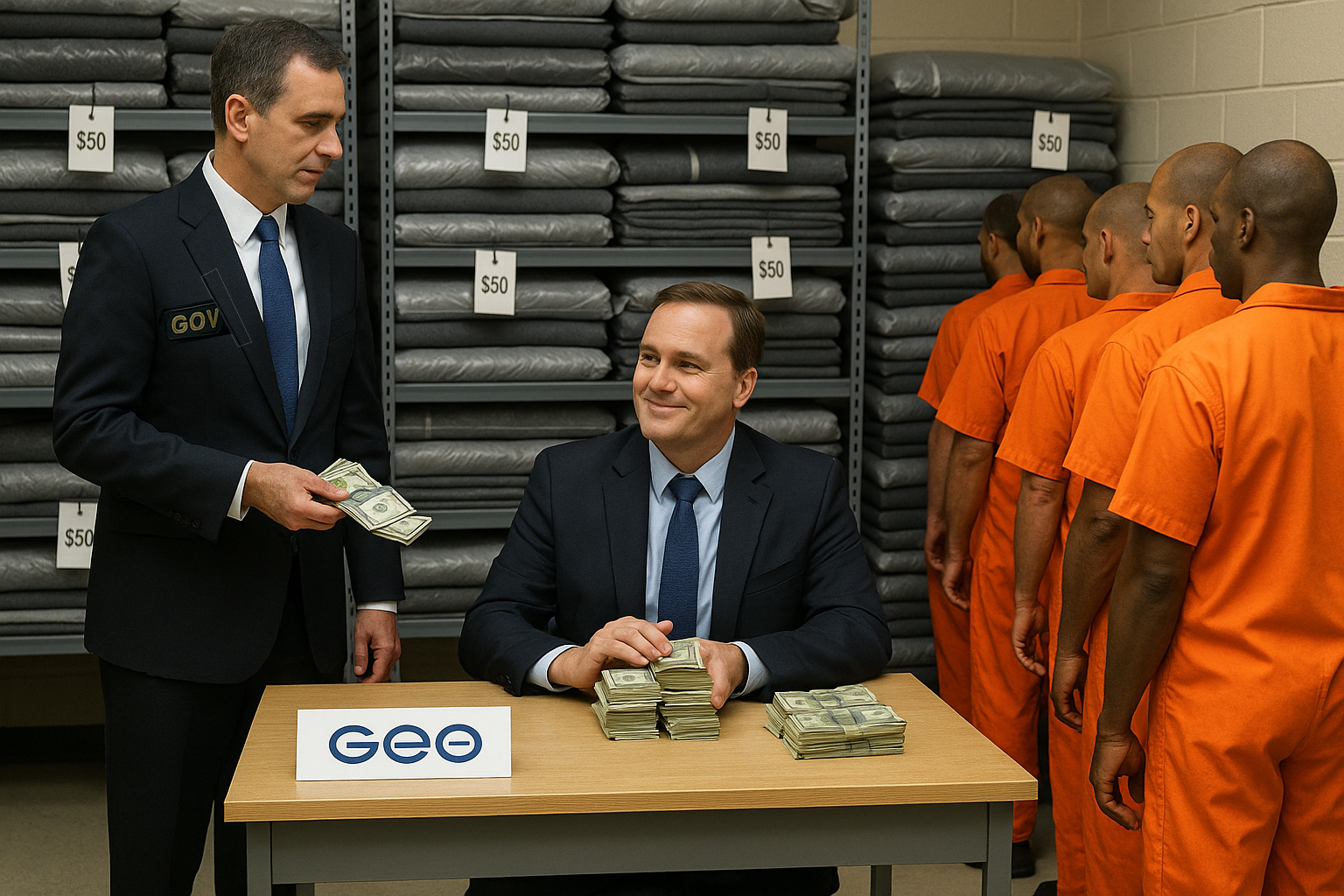
The rise of private incarceration in the United States has transformed detention from a public responsibility into a lucrative enterprise. Companies like The GEO Group and CoreCivic have perfected a model that monetizes human confinement, billing governments by the day for each occupied bed. This system turns jail cells into revenue streams and sentencing into supply-chain management.
THE PRIVATE-PRISON BUSINESS MODEL
At the heart of this carceral economy is the daily-rate deal:
Daily-Rate Billing: Governments pay private operators a fixed rate for each detainee per day, often at prices that rival or exceed comparable public facilities.
Guaranteed Bed-Filling Clauses: Contracts commonly include “lock-in” provisions guaranteeing payment for 80–100% of design capacity, even if beds remain empty.
Rapid Expansion, Limited Oversight: Facing overcrowding, agencies outsource construction and management to private firms, trading transparency and public oversight for off-balance-sheet convenience.
Each inmate becomes a living invoice. When beds translate directly into dollars, incentives shift: shrinking incarceration rates threaten corporate profits.
A MARKET BUILT ON CONFINEMENT
The financial logic is chilling:
In May 2005, ICE terminated GEO’s contract after discovering GEO was charging \$225 per day, over four times the \$53 per-day public-sector average (AFSCME Affiliate Staff Portal).
Private facilities typically bill between \$50–\$90 per inmate per day, embedding healthy profit margins under the guise of comparable costs (Corte IDH).
Guaranteed-occupancy clauses enforce a “take-or-pay” structure, ensuring revenue even when crime rates fall.
Implication: To sustain profitability, these companies benefit from policies that inflate arrests, extend sentences, and amplify detentions, be it through stricter immigration enforcement or punitive sentencing laws.
A CARCERAL ECOSYSTEM, NOT JUST PRISONS
Private-prison operators have vertically integrated across the detention lifecycle:
Rehabilitation & Reentry Under programs like “GEO Continuum of Care®,” companies sell education, therapy, and vocational training, often for additional fees.
Electronic Monitoring GPS ankle bracelets and “house arrest” programs convert private homes into pay-per-day detention sites.
Mental-Health & Juvenile Facilities Firms now run secure psychiatric centers, mimicking prison per-diem structures that guarantee Big Pharma both a captive patient base and a lucrative partnership to push medications.
Global Partnerships Public-private contracts span federal, state, and international agencies, blurring lines between government oversight and corporate control.
This network creates an ecosystem engineered to perpetuate its own growth, ensuring persistent demand for beds, physical or virtual.
CASE STUDY: ALLIGATOR ALCATRAZ
In July 2025, Florida unveiled “Alligator Alcatraz,” a 5,000-bed emergency camp in the Everglades:
Emergency Procurement: Governor DeSantis declared a “state of emergency,” fast-tracking contracts and sidestepping standard competitive bids and environmental reviews.
\$245 Million in Contracts: Within 30 days, private firms secured massive per-diem and service agreements, collecting daily fees without assuming real-estate risk.
Contractor Windfalls: Security, logistics, and construction companies with political ties profited handsomely, proving that crisis breeds cash flow.
Surrounded by swamp and razor wire, Alligator Alcatraz stands as a stark emblem of carceral capitalism thriving under the guise of crisis response.
THE MORAL COLLAPSE OF PROFITABLE PUNISHMENT
When imprisonment is a business, justice unravels:
Judicial Corruption: Between 2003 and 2008, Judges Ciavarella and Conahan accepted kickbacks to send over 2,500 children to for-profit juvenile facilities, often for minor infractions, lining private pockets at the expense of young lives .
Eroded Government Control: Guaranteed-occupancy clauses tie policymakers’ hands, effectively outsourcing sentencing and penal policy.
Criminalizing the Mundane: In Hillsborough County, Florida, Irena Green spent seven days in jail, for brown grass and a dirty mailbox, after her HOA escalated property-covenant violations into contempt charges (People.com, ABC Action News Tampa Bay (WFTS)).
In one recent Florida case, homeowner Irena Green spent seven days in jail for HOA violations, brown grass and a dirty mailbox. Though she complied with cleanup orders and sold her van to pay fines, she missed a court notice and was jailed for contempt. Her case, covered by Fox 4, People, and AOL, illustrates how even the mundane can become criminalized when systems are wired for extraction.
THE PHARMA-PRISON NEXUS
One of the most insidious expansions of profitable punishment is the integration of the pharmaceutical industry into the incarceration machine. As private operators moved into juvenile and mental health facilities, they imported a profit model that treats behavioral disorders as billing opportunities.
Psychotropic Medication as Revenue: In private youth detention and psychiatric centers, diagnoses of ADHD, depression, and bipolar disorder are disproportionately high. Medications are administered not always as treatment, but as behavior control, each prescription subsidized by Medicaid or state contracts.
Lobbying and Legislation: In 2024, lobbying expenditures by the pharmaceutical industry exceeded $400 million, more than defense contractors and oil combined. Among their targets: mental health legislation tied to juvenile justice reform. Bills that increase state reimbursements for mental health “treatment” in carceral settings were quietly supported by both prison companies and pharma giants.
Captive Market Exploitation: Detained individuals, especially juveniles, lack the ability to consent freely, challenge diagnoses, or refuse medication. The result: a system where diagnosis becomes diagnosis-for-profit.
This collaboration rewards over-medication and undermines public health. It’s not about healing, it’s about harnessing bodies for perpetual billing.
THE COST OF FALSE ECONOMY
Some political parties and policymakers argue that private prisons save money, but that claim collapses under scrutiny
Undocumented immigrants, for example, paid $96.7 billion in federal, state, and local taxes in 2022, averaging $8,889 per person, yet remain barred from receiving many benefits they help fund.
Mass arrests remove these taxpayers from the workforce, eroding IRS revenue, and force new leasing of detention beds, effectively transferring funds from public coffers to private contractor profits. In effect, In effect, the money “saved” by denying benefits is funneled into private incarceration firms billing per head, per day.
PUBLIC SAFETY OR PRIVATE PROFIT?
The rise of for-profit detention, from mental health facilities to migrant camps to digital monitoring, reveals not just a broken justice system, but a profitable one. One engineered to expand, not to resolve. A system where taxpayers foot the bill, private companies cash the check, and human lives are reduced to recurring revenue.
This isn’t just an economic failure. It’s a moral collapse.
When we tether justice to profit, cruelty becomes cost-effective. Judges become suppliers. Prison beds become quotas. And the law itself bends to serve the balance sheet.
We are not arguing for an end to incarceration. But we must end the monetization of it.
Because so long as punishment remains profitable, justice will remain compromised, and freedom, for sale.
The question is no longer whether we can afford to end private detention, but whether we can afford the moral cost of keeping it.
Trump Administration: The Counter-Revolution Against Minority Ascension
The attack on DEI is only one piece of a larger political pattern. From education to voting power, civil-rights enforcement, and historical memory, the Trump administration’s policies reveal a broader effort to weaken the roots of minority influence before it becomes permanent power.
How the rollback of affirmative action, DEI, civil-rights enforcement, historical memory, and voting power exposes a broader struggle over who is granted the legitimacy to shape America’s future.
The Trump administration’s attack on DEI, affirmative action, race-conscious admissions, civil-rights enforcement, Black historical memory, and minority voting power should not be viewed as a series of disconnected policy disputes. Viewed separately, each action can be defended with familiar language: merit, neutrality, fairness, tradition, patriotism, efficiency, or colorblindness.
But viewed together, a clearer pattern emerges.
This is not simply a debate about diversity programs. It is a struggle over who gets access to the institutions that produce power.
Education produces power. Voting produces power. Public office produces power. Historical memory produces power. Civil-rights enforcement produces power. Data collection produces power because it reveals who is being excluded. Congressional districts produce power because they decide whose community becomes politically visible and whose community is divided until it becomes weak.
That is why these areas are being targeted at the same time.
The argument sold to the public is simple: America must return to merit. But the deeper political effect is different. By attacking the tools that helped minorities enter schools, workplaces, government, museums, courts, and voting districts, the administration is not merely removing “identity politics.” It is weakening the legal and institutional bridges that allowed historically excluded groups to climb into decision-making spaces.
This is where the real battle is.
Minority communities did not gain influence overnight. They gained it through decades of legal fights, civil-rights protections, educational access, voting-rights enforcement, public pressure, and representation. Those tools did not create unfair advantage. They were created because the system had already been unfair for generations.
So when those tools are suddenly described as the problem, the question becomes obvious: problem for whom?
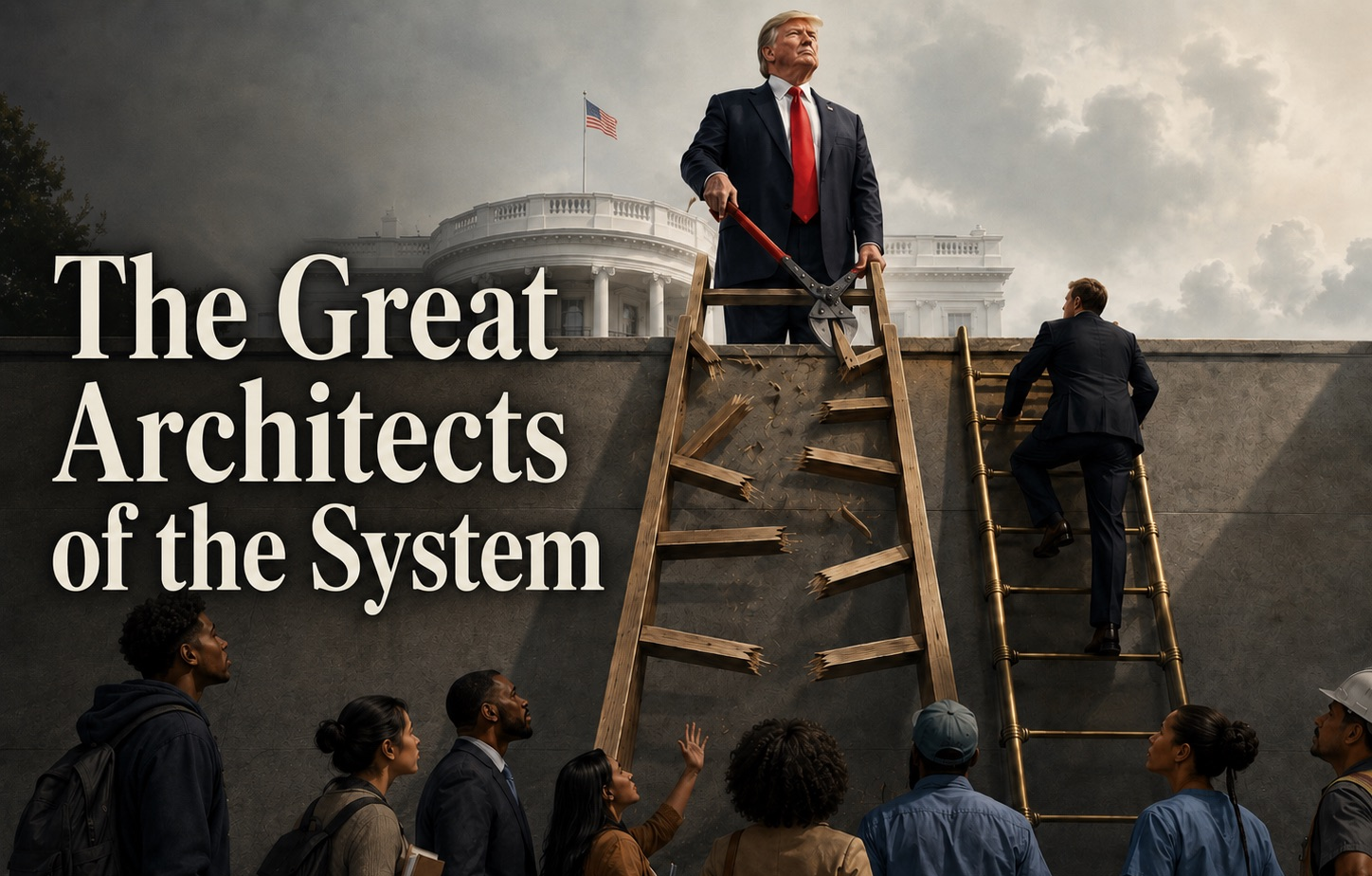
For communities that were historically locked out, DEI, affirmative action, voting protections, and civil-rights enforcement are not abstract political slogans. They are access points. They are doors. They are ladders. They are evidence-gathering mechanisms. They are legal weapons against invisible discrimination.
For those who benefited from the old structure, however, those same tools look like a threat.
That is the central contradiction. The administration claims it is restoring fairness, but the policies repeatedly move in one direction: away from minority access and back toward institutional control by the existing power structure.
The attack on DEI reduces minority entry into professional and educational pipelines.
The attack on affirmative action narrows race-conscious remedies in admissions.
The attack on disparate-impact liability weakens one of the most important legal tools for challenging policies that appear neutral but produce unequal results.
The pressure on museums and public history reshapes national memory by reducing the visibility of slavery, segregation, systemic racism, and Black resistance.
The weakening of workforce race and gender data collection makes discrimination harder to prove because what is not measured is easier to deny.
The redrawing of congressional districts can split Black communities apart, reducing their ability to elect representatives of their choice.
The blocking or obstruction of Black political leadership, as seen in cases like Newbern, Alabama, shows how local power can resist democratic outcomes when a Black candidate actually gains authority.
Each move touches a different institution. But the direction is the same: reduce the tools that allow minorities to transform population, education, and civic participation into actual power.
That is why this is bigger than policy. It is a counter-revolution against minority ascension.
Democracy, when it functions honestly, slowly redistributes influence. It allows people once excluded from power to organize, vote, study, lead, govern, and rewrite the national story with their own presence. That is the promise of democracy. But it is also the reason democracy becomes threatening to those who confuse their dominance with national stability.
When minorities gain access to education, they compete for elite credentials.
When they gain access to voting rights, they change electoral outcomes.
When they gain access to public office, they influence budgets, laws, policing, schools, and courts.
When they gain access to historical institutions, they challenge the sanitized version of national memory.
When they gain access to civil-rights enforcement, they force institutions to explain unequal outcomes.
That is the point where democracy stops being symbolic and becomes material.
The backlash begins when representation is no longer decorative. A minority face on a brochure is acceptable. A minority vote deciding an election is not. A minority student in a university photo is acceptable. A minority class reshaping elite education is not. Black history as a celebration is acceptable. Black history as an indictment of national systems is not. Diversity as performance is tolerated. Diversity as power is resisted.
This is why the language of “merit” must be examined carefully.
Merit sounds neutral. But in a society built on unequal access, merit can become a shield for inherited advantage. If one group had generations of better schools, better neighborhoods, stronger networks, family wealth, political protection, and institutional familiarity, then removing corrective tools does not create fairness. It freezes the advantage already in place.
That is the quiet violence of so-called neutrality. It pretends the race is fair after some runners have been held back for centuries.
The same logic applies to history. A country that removes uncomfortable truths from museums and public lands is not becoming more patriotic. It is becoming more fragile. It is trying to protect national pride from national evidence.
History is not dangerous because it divides people. History is dangerous because it explains power. It shows who built the country, who was exploited, who was excluded, who resisted, and who inherited the benefits. Once people understand that, they stop accepting inequality as natural.
That is why controlling memory is part of controlling the future.
The same is true with voting districts. A vote is not only an individual act. It is collective power. If Black communities are broken apart across maps, their numbers remain the same, but their political strength is weakened. That is not democracy expanding. That is democracy being engineered.
This is the larger picture: the administration’s project is not simply to win elections. It is to reshape the conditions under which future elections, future schools, future workplaces, future courts, and future historical narratives operate.
In other words, the mission is not only to regain votes. It is to regain the roots of power.
Control the schools, and you control who enters elite society.
Control civil-rights enforcement, and you control who can challenge discrimination.
Control historical memory, and you control what the country believes about itself.
Control voting maps, and you control which communities can convert numbers into representation.
Control public institutions, and you control who appears legitimate.
This is why the pattern matters. A single policy can be explained away. A sequence of policies reveals direction.
And the direction is clear: reduce minority influence before it becomes permanent political power.
The deeper question is whether American democracy was ever designed to accept full equality once full equality began changing who holds authority. It is easy for a system to praise democracy when the same groups keep winning. The real test begins when democracy produces new leaders, new voters, new narratives, and new priorities.
That is the moment when the mask slips.
If democratic access allows minorities to rise naturally through education, voting, law, culture, and public office, then the existing power structure faces a choice. It can share power, or it can change the rules while still calling the system democratic.
The Trump administration’s actions suggest a fear not of disorder, but of replacement within the rules of democracy itself. Not replacement by invasion. Not replacement by conspiracy. Replacement by participation.
Not because it destroys democracy, but because it proves democracy can dissolve inherited dominance when access becomes real.
So the question is not whether democracy is under pressure. The question is whether democracy is only accepted when it protects the old hierarchy. If equal access begins to produce equal power, and the response is to dismantle the mechanisms that made that access possible, then the system is not defending merit. It is defending control.
That is the pattern.
And once the pattern is visible, the debate changes. This is not about isolated reforms. It is about whether America will allow the communities it once excluded to become full architects of the country’s future, or whether the language of neutrality will be used to push them back before they reach the center of power.
What we’re witnessing is not a clash of good versus evil, but a confrontation between actors operating with the same playbook, pressure, leverage, and calculated destabilization. The difference isn’t behavior. It’s permission. Who gets a pass, and who gets punished for doing the same thing.
For decades, the global order, largely shaped by the United States Department of Defense and reinforced through alliances like NATO, was framed as “stability.”
That word deserves scrutiny.
Because what was labeled stability was, in practice, enforced dominance.
At its peak, the U.S. maintained over 800 military bases across more than 70 countries. The Fifth Fleet in Bahrain didn’t simply protect peace, it secured control over the Strait of Hormuz, where roughly 20% of the world’s oil supply transits daily.
That isn’t neutrality. That’s leverage.
And leverage always serves the one holding it.
Now that leverage is being tested, the language is shifting.
Iran has not replaced U.S. power, but it has exposed its limits. Reach has expanded. Costs of disruption have dropped. Influence no longer requires direct confrontation. Even the International Monetary Fund has warned that prolonged instability in the region could trigger global economic shock through energy volatility and supply disruption.
“America has no permanent friends or enemies, only interests.”
That logic didn’t fade. It became the system.
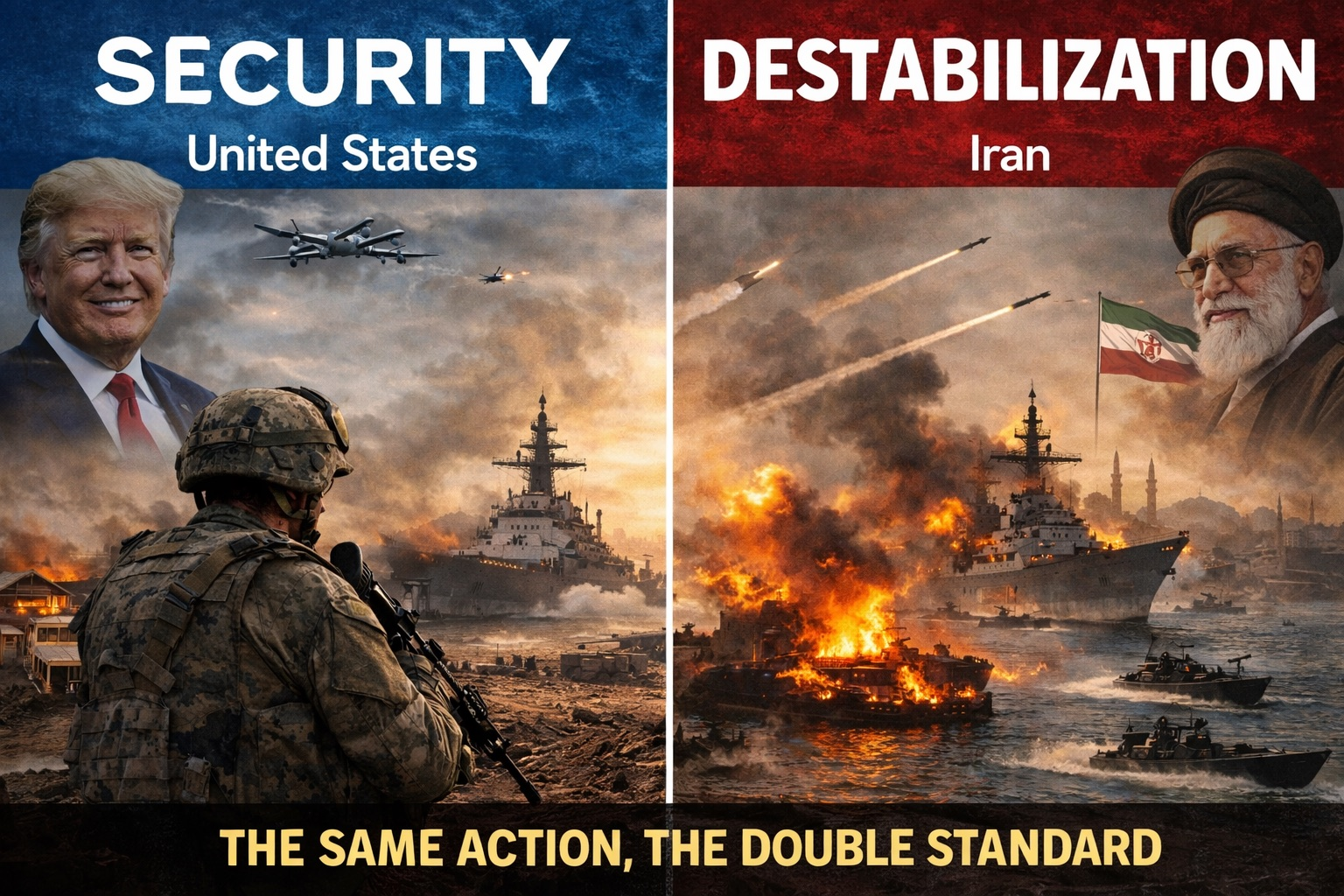
So when the U.S. pressures a corridor, it’s “security.” When Iran does the same, it’s “destabilization.”
Same mechanism. Different label.
And that label is the shield.
Because language is how power protects itself.
Even “freedom of navigation” is conditional, applied as principle when aligned, framed as crisis when challenged.
This isn’t accidental. It’s structural.
As John Mearsheimer argues, great powers are driven to dominate, not out of ideology, but because the system rewards it.
Iran isn’t breaking the rules.
It’s operating within them.
And that’s what makes this moment destabilizing.
Because the system only holds when one actor can impose consequences without facing them.
That condition is fading.
What’s emerging is not the collapse of power, but the end of uncontested power.
And once dominance becomes contestable, the cost rises everywhere:
Deterrence demands constant escalation
Supply chains require rerouting and redundancy
Energy markets embed risk
Diplomacy becomes performance instead of function
This is how systems unravel, not through sudden collapse, but through rising cost that exposes their limits.
And at the center of it is not strategy, but ego.
Leadership that confuses pressure with control. Institutions clinging to narratives that no longer match reality.
The outcome is already visible:
Escalation without control. Power without certainty. Cost without accountability.
Let’s be clear.
The world is not becoming more moral.
It is becoming more transparent.
The United States is not uniquely aggressive. Iran is not uniquely destabilizing.
Both operate on the same logic:
Apply pressure. Control flow. Shift cost.
The only thing changing is permission.
Who can act without consequence, and who cannot.
And that shift, more than any strike or deployment, is what is reshaping the global order.
Because once the illusion of control fades, power doesn’t disappear.
It gets negotiated.
Let’s stop pretending this is about morality.
What we are watching unfold is not a clash between right and wrong, it is a transfer of leverage between two powers that ultimately speak the same language: force, pressure, and control. The only difference is tolerance, who the system allows to act without consequence, and who it labels a threat for doing the same.
For decades, U.S. “stability” in the Middle East was never neutral. It was enforced dominance. Military bases, naval fleets, and security guarantees didn’t create peace, they created compliance. The flow of oil through the Strait of Hormuz remained smooth not because the system was fair, but because it was controlled.
And controlled systems always benefit someone.
Now that control is being challenged.
Iran has not replaced U.S. power, but it has exposed its limits. Bases that once symbolized untouchable authority are now within reach. Supply lines once considered secure now carry risk. The system didn’t collapse, it lost its certainty. And once certainty disappears, dominance becomes negotiation.
Call it disruption. Call it escalation. But don’t call it new behavior.
Because the mechanism is the same.
Pressure the corridor. Influence the flow. Shift the cost.
The difference is that when one actor does it, it’s called “security.” When the other does it, it’s called “destabilization.”
Same action. Different label.
And that label determines who gets tolerated, and who gets punished.
Meanwhile, the cost is exploding.
This war is no longer measured in missiles alone. It is measured in:
tens, if not hundreds, of billions in military expenditure
rising insurance premiums on global shipping
energy markets pricing in permanent instability
supply chains slowing under geopolitical risk
The global economy is now absorbing the consequences of a system that believed it could operate indefinitely without pushback.
And at the center of this acceleration is not strategy, but ego.
The collapse of diplomacy is not accidental. It is the result of leadership that mistakes pressure for control, and arrogance for strength. When negotiation is replaced by posturing, escalation becomes inevitable, and expensive.
This is how systems break, not through sudden collapse, but through rising cost that no one wants to admit is unsustainable.
The uncomfortable truth is this:
The world is not entering a new moral order. It is entering a more honest one, where power is no longer hidden behind language, and control is no longer uncontested.
The U.S. is not uniquely aggressive. Iran is not uniquely disruptive.
They are operating within the same logic.
The only thing changing is who gets away with it.
And that shift, more than any missile or strike, is what is shaking the system.
At first glance, the alliance between the United States and Israel appears counterintuitive when measured against traditional indicators of national strength. Unlike many of its regional counterparts, Israel does not possess abundant natural resources. It lacks significant oil reserves, faces chronic freshwater scarcity, and operates within a largely arid environment where natural agricultural expansion is structurally limited.
To compensate, the country has invested heavily in large-scale desalination infrastructure, transforming seawater into potable supply. This system is technologically advanced and widely regarded as one of the most efficient in the world. However, it comes at a measurable cost: estimates suggest Israel spends hundreds of millions of dollars annually operating its desalination network, with long-term contracts and energy inputs pushing total lifecycle costs even higher. The system sustains agricultural and urban demand that would otherwise be constrained—effectively engineering resilience rather than drawing from naturally abundant conditions.
This raises a structural question when examining Israel’s positioning as a global technology hub. Advanced infrastructure, particularly data centers, semiconductor activity, and high-performance computing, requires stable access to both water and energy. While Israel has compensated through innovation, scaling such infrastructure domestically remains resource-intensive. As a result, long-term technological expansion may increasingly depend on outward integration, through partnerships, offshore infrastructure, or by extending influence into neighboring regions via colonization, territorial encroachment, or enforced economic expansion where natural resource conditions are more favorable.
In that sense, growth does not occur purely within borders, but through projection beyond them.
From a demographic and structural standpoint, Israel also operates within constraints. Its relatively small population limits total labor capacity and military depth when compared to larger regional actors. These limitations are offset through high levels of training, technological integration, and strategic doctrine, but the issue of scale remains structural rather than temporary.
The question of advanced military capability introduces an additional layer of complexity. Israel is widely understood to possess nuclear capabilities, although it maintains a policy of deliberate ambiguity. The development of such systems historically requires decades of research, deep scientific infrastructure, and cumulative generational knowledge. Given Israel’s relatively recent statehood, this has led to long-standing assessments that external cooperation—particularly with the United States, played a role in accelerating technological and defense maturity, directly or indirectly.
Similarly, while Israel maintains a highly advanced military, a significant portion of its equipment, fighter aircraft, missile defense systems, naval assets, and munitions—is either imported, co-developed, or heavily financed through external support. The United States provides approximately $3.8 billion annually in military aid, in addition to joint development programs and access to advanced systems. When factoring procurement, maintenance, and replenishment of high-intensity military operations, the broader cost structure of sustaining Israel’s defense posture extends well beyond its domestic production base.
This raises a fundamental accounting question: what is the true cost of military independence when core components are financed, supplied, or technologically enabled by an external power?
Which brings us back to the foundation of the alliance.
If not resource wealth, not demographic scale, and not fully self-contained industrial capacity, the answer increasingly points toward geography. Israel occupies a uniquely strategic position at the crossroads of the Eastern Mediterranean and the Middle East, within proximity to critical trade routes, energy corridors, and geopolitical fault lines. In this sense, its value may derive less from internal abundance and more from its role as a forward-positioned strategic anchor for the United States.
However, when viewed through this lens, the relationship begins to resemble structural asymmetry. Israel’s resilience, economic, military, and infrastructural, appears, at least in part, externally reinforced. The system functions not purely as mutual strength, but as sustained alignment supported by continuous input.
This leads to a broader reflection: whether the alliance is truly grounded in balanced power, or whether it reflects a strategic placement maintained through ongoing support, what could be interpreted as a form of geopolitical life support for the only non-Muslim-majority state in the region, rather than purely independent leverage.
Which raises a more uncomfortable question.
Why does Israel project such a high degree of authority, confidence, and unilateral power, when, on paper, many of its core systems, water, defense, advanced equipment, and even aspects of technological scaling, are either engineered, externally supported, or partially dependent on outside inputs?
It is not that Israel lacks capability. It is that much of that capability exists within a framework where key advantages are reinforced from beyond its borders.
A state where resilience is, to a significant extent, constructed.
Where sustainability is engineered.
And where strategic strength may be less organic than it appears, raising the question of whether what is being sustained is not just a nation, but a position.






 Entertainment1 year ago
 Opinion1 year ago
 Tech1 year ago
 Economy1 year ago
 Sports1 year ago
 Entrepreneur1 year ago
 Opinion11 months ago
 Culture1 year ago