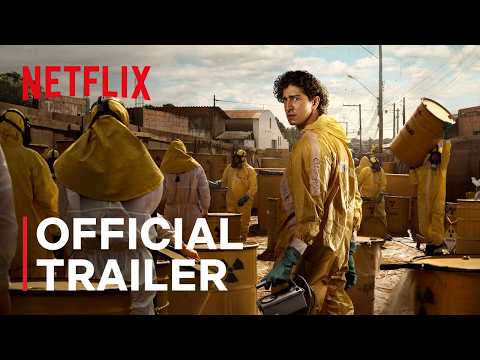
Netflix didn’t just tell the story of the Goiânia disaster.
It recast it.
What happened in 1987 was one of the worst civilian radiological accidents in history, a chain reaction of ignorance, exposure, and institutional failure after a radioactive source was removed from an abandoned clinic and circulated through a scrapyard network.
It spread the way real disasters spread: through proximity, through trust, through human error.
On paper, this is a story about radiation.
On screen, it becomes something else entirely: a story about who gets to embody suffering, and who doesn’t.
When Accuracy Becomes Selective
The real Goiânia disaster had no racial script.
Victims were linked by contact, not identity: scrapyard workers, relatives, neighbors, people pulled into the same invisible chain of exposure. Contamination moved through touch and curiosity, not through any demographic divide.
The fatalities reflect that reality. They came from the same working-class network, including a child, all connected by proximity to the source, not by any constructed contrast between groups.
Even the most documented case, six-year-old Leide das Neves Ferreira, complicates the visual narrative imposed by the series. Her real-life identity, widely recorded at the time, does not align with the pattern the adaptation leans into.
Because on screen, a different logic takes over.
A pattern emerges:
The exposed, the contaminated, the suffering → disproportionately darker-skinned
The analysts, the authorities, the ones in control → more often lighter-skinned
One instance might be incidental.
A repeated structure isn’t.
Not an Error, A System
This is where the series stops being a dramatization and starts following a template.
Because this pattern didn’t start here.
Across global media, the same visual hierarchy keeps resurfacing:
Vulnerability has a look
Authority has a different one
Chaos is embodied
Control is institutional, and visibly separate
“Radioactive Emergency” doesn’t invent this language. It speaks it fluently.
Even at the level of intimate storytelling, the symbolism holds. Within affected families, visual contrast is preserved, not just narratively, but aesthetically. The result isn’t accidental nuance. It’s coded familiarity.
This is how modern bias operates: not declared, not explicit—just repeated until it feels natural.
Creative License, or Convenient Flexibility?
The defense is obvious: artistic interpretation.
And that argument holds, until it doesn’t.
Because the series, created by Gustavo Lipsztein, is meticulous where it chooses to be:
The physics of radiation
The progression of symptoms
The timeline of contamination
Precision everywhere.
Except in representation.
That’s where realism loosens. Patterns appear. Consistency disappears.
You don’t get to claim authenticity while selectively bending the human reality at the center of the story.
That’s not creative freedom.
That’s curation.
Rewriting Memory in Real Time
“Based on a true story” is not a neutral label.
It’s a claim on memory.
For most viewers, this version is Goiânia. There is no competing reference point. No footnote. No correction.
So when representation shifts, memory shifts with it.
And what gets lost isn’t just accuracy, it’s context:
A complex, mixed social fabric flattened into visual shorthand
A disaster driven by exposure reframed through familiar imagery
A reality replaced by something more recognizable, but less true
Over 100,000 people were examined. Hundreds were contaminated. Not by race, but by contact.
That distinction isn’t minor.
It’s the difference between history and narrative.
The Industry Pattern Hiding in Plain Sight
This is bigger than one series.
The real question isn’t whether media reflects bias.
It’s whether it keeps standardizing it. quietly, consistently, visually.
Because the roles rarely change:
Who is shown as exposed?
Who is shown as helpless?
Who is shown as needing intervention?
And on the other side:
Who analyzes?
Who contains?
Who restores order?
These aren’t random distributions.
They’re patterns.
And patterns, repeated often enough, stop being noticed, and start being believed.
Conclusion
“Radioactive Emergency” succeeds in recreating the fear of invisible contamination.
But it also reveals something far more familiar: how easily reality can be reshaped, not by what is said, but by what is shown.
The Goiânia disaster was not a racial allegory.
It didn’t need one.
But when storytelling begins to assign roles instead of reflect them, subtly, visually, repeatedly, it stops documenting tragedy and starts redesigning it.
And at that point, the most dangerous form of exposure isn’t radioactive.