“Market capitalization”, the share price multiplied by the number of outstanding shares, is widely presented as a concrete measure of a company’s value. Analysts use it to define tiers, set expectations, and argue valuation ceilings. But in reality, market cap is a mirage, a hollow metric that conceals more than it reveals, especially when confronted with the unseen forces that govern modern financial markets.
A Fiction Built on Assumptions
Market cap assumes a fair and transparent marketplace, where share price is dictated by natural supply and demand, and the share count is fixed and enforced. But these conditions no longer exist, not in a market where hedge funds and financial institutions routinely distort prices through manipulative strategies that operate outside the bounds of official reporting.
Tools such as naked short selling, synthetic shares, off-book transactions, dark pool trading, and share dilution allow powerful players to move capital at a scale that completely outpaces the official market cap. The result? A stock that may be listed with a $1 billion market cap could easily have several billion dollars’ worth of unofficial exposure, none of which is visible to retail investors or reflected in the official data.
Synthetic shares, for example, are essentially IOUs, created through derivatives or improper shorting, that inflate the apparent supply of a stock without actually existing. They aren’t counted in official share totals, but they affect price and liquidity all the same.
Retail investors are constantly reminded to “trust the fundamentals” and respect market cap limits. When enthusiasm drives a stock upward, media voices and institutional analysts rush to declare it “overvalued,” using market cap as a ceiling:
“It can’t go that high. It would be worth more than Apple!”
But when institutions flood the system with synthetic shares, sell phantom stock, or manipulate supply-demand balance behind closed doors, there’s no similar outcry. The same voices stay silent. No one questions whether the crashed price still reflects “fundamentals” when it has been artificially suppressed.
This selective application of logic isn’t a fluke, it’s structural. Whether by design or evolution, today’s market architecture limits upside for the public while allowing institutional players to extract profits from the shadows.
The Overflow That Never Reaches the Public
What makes this even more absurd is that the money moved via these unofficial, manipulative strategies often exceedswhat the official market cap would even allow. If synthetic shares, naked shorts, and off-book transactions were actually counted in the market’s capital flow, it would become obvious that the idea of a “fundamental market cap” is nothing more than a myth, a convenient fiction.
The system isn’t designed to reflect value, it’s designed to capture and contain it. The overflow, the excess demand, the explosive momentum retail investors try to generate, never reaches the surface. That value is quietly siphoned away, diverted through hidden mechanisms: absorbed into dark pools, sold off through phantom shares, or suppressed algorithmically before it can ever materialize.
When financial institutions and market makers find themselves caught in an unexpected reverse trend, holding over-leveraged short positions built on synthetic or counterfeit shares they face the threat of catastrophic losses. But instead of closing those positions and taking the hit, as retail traders must, they often manipulate the company or market structure to bail themselves out.
One of the prime tactics? Pressuring the company into a reverse stock split. Reverse splits consolidate the float, reset the share count, and effectively erase synthetic positions from visibility, without ever requiring a true buyback or cover.
In many cases, reverse splits:
Wipe out retail momentum
Demoralize long-term investors
Let institutions walk away untouched, without reconciling counterfeit liabilities
And because the post-split share price is temporarily elevated, retail investors are left disoriented. What once felt like momentum now looks like a trapdoor.
This process is rarely addressed in financial media. But it serves as a systemic loophole, allowing hedge funds to launder their failed positions through “corporate restructuring” rather than face accountability.
Conclusion: A System Built to Extract, Not Reflect
If financial markets were truly honest, market cap would be an evolving expression of collective belief and economic potential. But in today’s system, it’s a gatekeeper, a talking point used to cap retail ambition, even as institutions secretly rewrite the rules behind the scenes.
Whether by loophole, lag in enforcement, or outright evasion, the current market model allows powerful players to reshape the playing field in real time, while retail traders are asked to “trust the process” using metrics that no longer mean anything.
The financial world isn’t built to reflect fair value. It’s built to restrict access to it.
Until these contradictions are acknowledged, challenged, and structurally addressed, retail investors will continue to play a rigged game, one where the scoreboard is manipulated, the referees are silent, and the real money moves where no one is allowed to look.
How Financial Institutions Manufacture “Winners” and Trap Wealth at the Top
Finance does not create value, it redirects it. What looks like market success is often capital concentration mistaken for merit. Blue-chip companies are not discovered by markets; they are reinforced by money.
The First Illusion: That Finance Is the Source of Wealth
Let us begin with the strongest version of the opposing argument.
Finance, we are told, creates value by:
Allocating capital efficiently
Pricing risk
Providing liquidity
Accelerating innovation
All of this is functionally true.
And yet it obscures a more fundamental reality.
Finance does not create primary value. It does not generate new goods, new labor, new energy, or new ideas.
What finance creates is movement:
Movement of capital
Movement of risk
Movement of ownership
Movement of claims on future production
Finance is not the engine. It is the transmission.
And a transmission, no matter how sophisticated, cannot move without power already generated elsewhere.
No surplus → no deposits No deposits → no leverage No leverage → no derivatives No derivatives → no exponential returns
This is not a moral critique. It is a mechanical one.
Finance is structurally dependent, not generative.
More precisely: labor creates value once; finance monetizes that value indefinitely through layered claims.
Why Financial Institutions Chase the Wealthy, and Ignore Everyone Else
Because capital is not the product.
It is the raw material.
A financial institution without capital is a refinery without crude oil. This is why banks, asset managers, and funds aggressively court:
Ultra-high-net-worth individuals
Corporate treasuries
Pension systems
Sovereign wealth funds
Retail investors matter only at scale. Large capital holders matter individually.
This reveals the system’s real hierarchy:
Labor sustains the economy. Capital sustains finance.
Which is why finance does not primarily serve workers, consumers, or innovators.
It serves those who already control money.
The wealthy are not clients. They are inputs.
Blue-Chip Companies Are Not “Safe” They Are Selected
“Blue chip” suggests reliability, stability, and merit earned over time.
In practice, blue-chip status is constructed.
Not discovered.
The Selection Loop
A modern blue chip emerges through a predictable and repeatable sequence:
Financial institutions concentrate capital into a firm or sector
Analyst coverage signals legitimacy
Index inclusion forces passive inflows regardless of valuation
Liquidity dominance attracts secondary capital
Cheap debt enables buybacks and acquisitions
Competitors starve, not from inferior ideas, but from inferior access to capital
At this point, performance becomes secondary.
Capital itself predefines success, then retroactively calls it merit.
This is not competition. It is capital-assisted natural selection.
Once a firm becomes systemically owned, its survival becomes politically mandatory. Markets no longer evaluate the company. They protect it, because its failure would expose the fiction of market discipline itself.
Big Tech Was Not Inevitable, It Was Reinforced
Apple, Microsoft, Amazon, and Google are often described as inevitable winners.
They were not.
They were continuously reinforced.
By the early 2020s, the five largest technology firms accounted for over a quarter of the total market capitalization of the S&P 500, forcing trillions of dollars in passive investment to flow into the same names regardless of fundamentals. This was not investor choice. It was index mechanics.
Capital followed structure, not analysis.
The reinforcement mechanisms were clear:
Massive institutional ownership consolidated voting power
Index inclusion created permanent demand
Cheap debt financed endless buybacks
Acquisitions neutralized threats before they matured
Once capital commits at scale, failure becomes unacceptable, not because of innovation, but because collapse would damage:
Pension funds
Index products
Institutional balance sheets
Political legitimacy
At that stage, success is no longer earned.
It is maintained by capital gravity.
Banking Consolidation: When Markets Quietly Exit
Since the 1990s, U.S. banking has collapsed into a handful of megainstitutions.
In 1984, the United States had over 14,000 commercial banks. Today, fewer than 4,200 remain, while the largest institutions control the majority of assets. This was not the result of natural efficiency alone. It was the outcome of policy preference for scale after each crisis.
JPMorgan Chase, Goldman Sachs, and Citigroup did not outcompete the market.
They absorbed it.
After each disruption, the rule remained consistent:
Large institutions are protected. Small institutions are expendable.
Failures were socialized. Mergers were encouraged. Risk was rewarded retroactively.
Competition did not disappear by accident.
It was removed because systemic size became indistinguishable from safety.
The free market did not fail. It was deemed inconvenient.
2008 Was Not a Breakdown, It Was a Stress Test
The 2008 financial crisis is often framed as betrayal.
That framing is comforting. And wrong.
2008 demonstrated that financial institutions could:
Privatize gains
Externalize losses
And survive intact
Trillions of dollars in guarantees, liquidity facilities, and asset purchases, many deployed off balance sheets, ensured that markets were never allowed to clear. Loss was not eliminated. It was redistributed downward.
The system did not collapse.
It proved its priorities.
Bailouts were not generosity. They were the price of dependency.
By concentrating risk at the top, institutions ensured that failure would be catastrophic enough to demand rescue.
This was not capitalism failing.
This was capitalism revealing its power hierarchy.
Derivatives: Profit Without Production
Derivatives are often praised as innovation.
In reality, they are synthetic claims.
They do not create wealth. They redistribute exposure.
Their profitability depends on:
Large capital pools
Stable narratives
Continuous inflows
Crucially, derivatives are frequently written on the same assets institutions promote as “safe.”
This creates a closed loop:
Institutions:
Shape asset narratives
Sell products based on those narratives
Trade volatility they influence
Help shape the regulations governing the market
Creator. Seller. Speculator. Regulator.
No external discipline required.
The Structural Truth: Finance Converts Surplus into Dependency
Finance cannot exist without value created elsewhere:
By labor
By production
By extraction
By innovation
It feeds on surplus.
As surplus grows, finance grows faster. As finance grows, it captures more surplus.
Over time, the host weakens.
Not individuals. Entire economies.
This is not conspiracy. It is structure.
Not corruption. Incentives.
Not failure. Design functioning as intended.
Why the Big Dog Always Wins
Because the system equates:
Capital concentration with legitimacy
Liquidity with safety
Scale with morality
Survival with truth
Blue-chip companies are not blue because they are virtuous.
They are blue because they are protected.
Which ensures that wealth:
Circulates among the same institutions
Rewards the same shareholders
Reinforces the same power structures
Innovation is welcomed only when it can be owned. Disruption is funded only when it can be controlled.
If you hold an index fund, a pension, or a retirement account, you are not observing this system.
You are fueling it.
Stability is not the benefit you receive. It is the justification used to keep you inside the loop.
The Blue-Chip Lie
Blue-chip companies are not winners. They are chosen survivors.
Financial institutions do not allocate capital efficiently. They allocate it strategically, to protect themselves.
Markets are not free. They are guided, reinforced, and rescued.
Finance does not reward merit. It rewards proximity to capital.
The big dog always wins, not because it is stronger, but because it is fed.
Final Diagnosis
The danger of this system is not that it fails.
It is that it succeeds, by concentrating risk upward, accountability downward, and wealth inward.
Finance does not malfunction. It performs exactly as designed.
And the longer it performs, the narrower the circle of winners becomes—until “the market” is no longer a place where value is discovered, but a mechanism where outcomes are enforced.
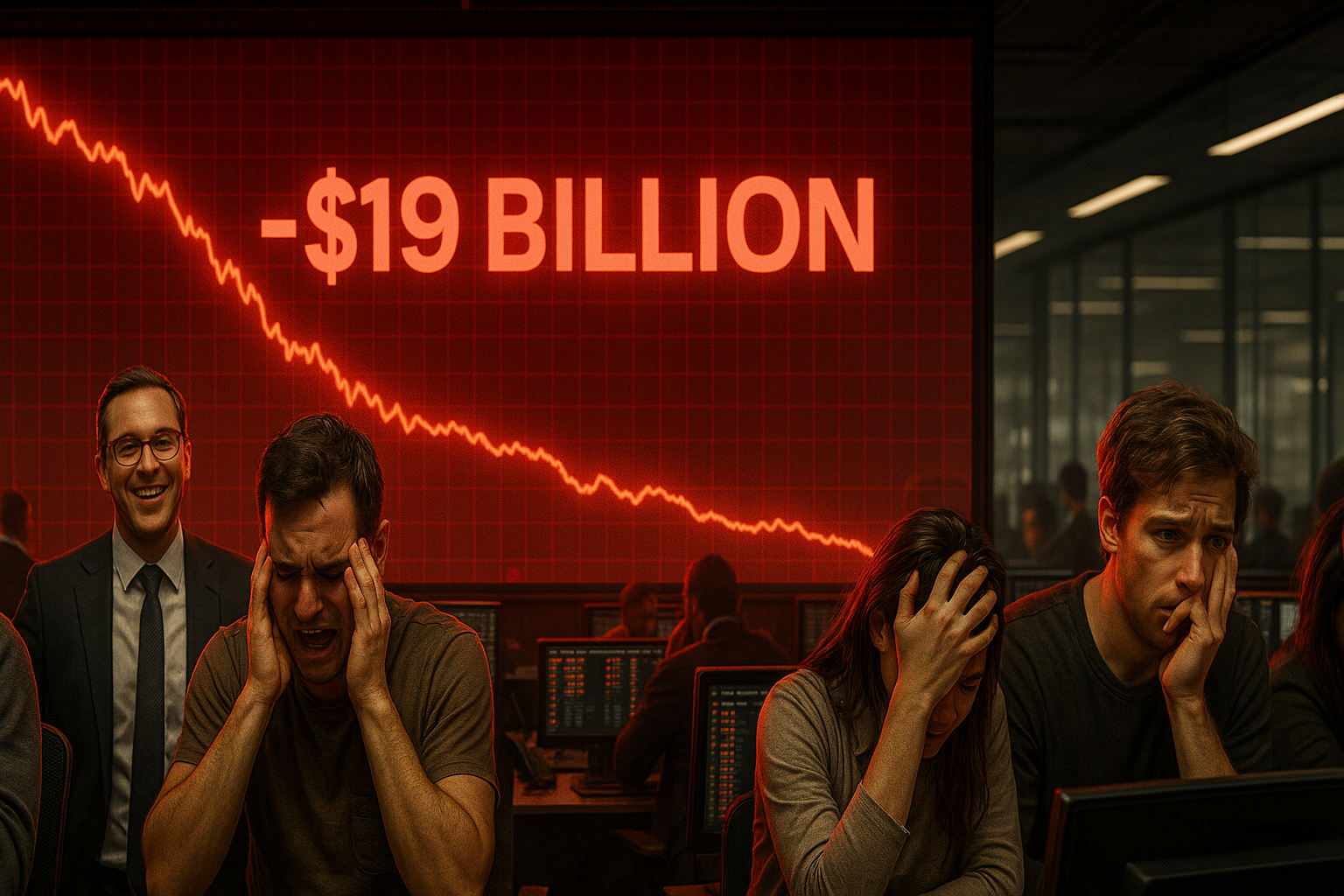
9:34 a.m. Eastern, Bitcoin began to free-fall. Within hours, over $19 billion in crypto positions vanished, marking the largest one-day liquidation in digital-asset history, according to data compiled by Investopedia.
Ethereum and other majors followed, crashing in perfect sync. Headlines pointed fingers at politics: Donald Trump had just announced 100 percent tariffs on Chinese tech exports, plus tighter controls on U.S. software. Markets were shaken, confidence cracked, and the story seemed complete.
But the behavior didn’t match panic. It was too fast, too clean, too synchronized. This wasn’t chaos, it was planned.
The Orchestrated Crash
Behind the scenes, whales, massive holders, and market-making firms that control exchange liquidity were quietly playing a different game. Reporting by CCNthat week showed roughly $60 million in coordinated sell orders hitting precise levels where retail traders had placed their stop-losses.
Once triggered, a cascade began: algorithms sold automatically, leverage unwound, and domino after domino fell.
“The result looked like hysteria but acted like a scripted detonation.”
When the smoke cleared, retail investors were staring at empty dashboards while insiders quietly loaded their bags at the bottom. They knew where the market would break, and exactly when to catch the rebound.
On-chain data later showed wallets (one traced as 0xF8a…) pulling over $88 million in profit in 30 minutes through perfectly timed shorts and buybacks.
The Old Trick, New Playground
It’s the oldest move in modern finance: manufacture panic, harvest profit.
The 2010 Flash Crash followed the same logic. One trader, Navinder Sarao, spoofed the market with fake orders that distorted supply and demand just long enough to trigger a chain reaction. Regulators called it manipulation; traders called it opportunity.
In crypto, the guardrails barely exist. Exchanges often play casino and dealer at once, making the odds unwinnable for anyone not inside the house.
The Whales’ Advantage
Whales see the market like an open book, literally. With access to full order data, they know where small players placed bets, how much leverage they used, and the exact price that forces liquidation.
It’s like knowing everyone’s cards before the game starts.
When enough traders gamble on borrowed money, one well-timed shove can topple the entire table.
“Liquidity is the oxygen of markets. When a handful of players hold the tank, everyone else gasps for air.”
By withholding supply or dumping strategically, they create the volatility they later exploit, a quiet monopoly over both information and liquidity.
The Power Transfer
To the average trader, October 10 looked like an economic event. In reality, it was a power transfer.
The crash reset prices low enough for big traditional institutions, BlackRock, Fidelity, JPMorgan’s digital desks, to walk in at wholesale levels. As one analyst wrote, “When you think crash, they think acquisition.”
Even seasoned hedge-fund traders admitted it felt unnatural. “No one slept,” one told Financial News London. But certain algorithmic wallets were anything but scared. They were executing thousands of trades per second, perfectly positioned for the rebound.
That doesn’t happen by luck.
The Perfect Cover Story
Politics became the smokescreen. Trump’s tariff announcement gave the media a clean headline while the real game unfolded in the dark corners of digital exchanges.
Binance and Coinbase saw billions in stablecoins shift minutes before the deepest plunge, a move that looks less like panic and more like rehearsal.
No regulator could trace it in real time. No retail investor ever saw it coming.
The Cycle of Control
By dawn, the institutions that once mocked crypto were richer, and more dominant, than ever. Power in finance never disappears; it simply changes form.
The same hands that move Wall Street’s gears now pull the strings of the digital economy.
Markets, crypto or otherwise, are never neutral. They’re shaped by those who own the infrastructure: the exchanges, the liquidity, and increasingly, the data.
“The rich don’t stay rich because they’re lucky. They stay rich because they sit next to the switch that turns the lights off for everyone else.”
The Lesson
Every crash writes two histories: one for the headlines, and one for the hidden hands. The crowd watches value disappear; the whales quietly inherit what’s left. And when the dust settles, the same puppet masters reach for the same switch.
You’ve been told that the stock market is a meritocracy, that prices rise and fall on fundamentals, that innovation is rewarded, and that anyone can build wealth if they “do their research.”
It’s a comforting idea. It’s also a dangerous illusion.
Behind the tickers and charts lies a structure designed not for you, the ordinary investor, but for the institutions that built and maintain it: hedge funds, market makers, and trading firms with faster information, privileged tools, and rules that bend in their favor.
Once you see how the game really works, it’s impossible to unsee.
The System Was Never Built for You
For retail investors, people trading from a phone or laptop, the market looks like a level playing field. But behind the screen, trades are already decided before your order even hits the system.
Institutions have something you don’t: speed, influence, and special exemptions. They can sell shares they don’t actually own, a practice called naked short selling.
When done in volume, these “phantom shares” flood the market with fake supply. Prices fall not because a company is weak, but because its stock is artificially diluted. This isn’t theory; it’s documented. And it’s devastating to small and mid-size companies that live or die by investor confidence.
The SEC has fined major institutions over naked short violations. Goldman Sachs, for example, paid $2 million in 2007 for allowing clients to illegally short shares before public offerings without borrowing them Wikipedia.
The Phantom Game: How Fake Shares Cripple Real Companies
Here’s how it works:
An institution sells shares it doesn’t own to another broker, creating IOUs.
These IOUs trade like real shares, inflating volume.
The price falls from the artificial oversupply.
Retail investors panic and sell.
The end result? The illusion of a free market begins to resemble a rigged casino.
Robert Simpson bought 100% of the outstanding float of Global Links Corporation in early 2005, about 1.15 million shares for just ~$5,200, and held them offline, in his sock drawer. Yet in the days that followed, over 60 million shares traded, nearly 60× the actual floatReddit.
This level of trading is physically impossible unless phantom shares circulated widely. Simpson’s case is often cited as one of the clearest real-world examples of counterfeit share manipulation.
Why Don’t CEOs Blow the Whistle?
Because it’s a career-ending move.
Speaking out about market manipulation can scare off investors, trigger lawsuits, and invite regulatory retaliation. Many leaders know their company is under attack but are forced to stay silent while watching their stock, and sometimes their business, be destroyed.
The Blue-Chip Shield
So why do hedge funds keep winning?
When hedge funds short small targets, they hedge their risk with blue-chip stocks, Apple, Amazon, Nvidia, Google, not just as investments, but as collateral.
Here’s the pattern:
They hold blue-chip stocks for stability.
At the same time, they short smaller companies using phantom shares.
If their short goes bad and the stock rises, they dip into their blue-chip holdings to cover their losses.
This strategy works until it doesn’t. If the shorted stock surges, even blue-chip collateral can’t save them. That’s when you hear about short squeezes, a panic-driven scramble to buy back shares, sending prices rocketing upward.
The entire system depends on keeping these smaller stocks suppressed. If prices are allowed to rise freely, the whole leverage house of cards starts to wobble.
The SEC’s Regulation: Slaps on the Wrist
At this point, you might be asking: Where are the regulators?
The answer is sobering: the watchdogs know.
The SEC routinely fines hedge funds and trading firms for illegal shorting, market manipulation, and other abuses. But those fines are almost always a fraction of the profit made from the misconduct. It’s the cost of doing business.
Worse: the fines collected go back to the same system that failed to protect retail investors.
For institutions, the equation is simple:
Commit fraud.
Pocket hundreds of millions.
Pay a fine that amounts to a small service fee.
Move on to the next scheme.
The victims, everyday investors and the companies themselves, rarely recover.
Example: Citadel Securities
In 2023, Citadel received a $7 million fine for mismarking millions of short-sale orders between 2015–2020, a violation of Regulation SHO Reddit. Citadel executes ~35% of U.S.-listed retail volume and 22% of all U.S. equities tradessolutions-atlantic.com.
Rule 105 Enforcement
Between 2005 and 2024, 19 firms were fined for shorting during restricted periods before public offerings. Combined, they paid just $9–10 million in penalties and disgorgements, even though illegal profits were often larger thestreet.com.
Galleon Management: made ~$1.04 million in illicit gains; paid ~$1.95 million total in penalty + disgorgement sec.gov.
GLG Partners: gained over $2.2 million illegally; fined only $3.2 millionthestreet.com.
Rule 105 Recent Case: Weiss Asset Management
Between Dec 2020 and Feb 2021, Weiss shorted securities and then participated in offerings of those same stocks, violating Rule 105. The SEC estimated $6.5 million in ill-gotten gains. Weiss paid only $200,000 penalty, plus disgorgement and interest: total ~$6.9 million sec.com.
The Magic Eraser: Reverse Splits
When manipulation goes too far and the short positions get risky, institutions have another trick: force the company into a reverse stock split.
A reverse split shrinks the number of shares on the market, multiplying the stock price while leaving the total value the same. It sounds harmless, but it does something extraordinary: phantom shares vanish.
Those IOU shares that were never officially issued and recorded? After a reverse split, they no longer exist on paper. It’s a magic eraser for the people who created the mess in the first place.
Retail investors, on the other hand, are left holding a position that almost always drops again after the split.
When They Want You Gone
In extreme cases, the goal isn’t just control, it’s eradication.
By hammering a company’s stock price below $1, they:
Threaten it with delisting from major exchanges.
Force repeated reverse splits.
Shatter investor confidence.
Eventually, the company is forced into bankruptcy or becomes so toxic that no one will invest. Meanwhile, the short sellers walk away with profits and no trace of their phantom shares.
The Safe Giants
This is why blue-chips dominate
The giants, Apple, Google, Amazon, are seen as safe because they are safe… for the system.
They act as financial anchors.
ETFs and retirement funds pour money into them.
Hedge funds use them as collateral to short everything else.
They benefit from inflows, algorithms, and passive buying.
They’re not the best because they started that way. They’re the best because the system needs them to validate its manipulation. They are the collateral that makes the entire rigged game possible.
Meanwhile, disruptive startups and emerging companies are suffocated before they can compete.
A System by Design
Here’s the hardest truth of all:
The market is not broken. It’s working exactly as designed.
A handful of institutions write the rules.
Phantom shares and short positions are their weapons.
Blue-chips are their shields.
The SEC applies fines that barely sting.
The retail investor, the person who thought they had a shot, is left to play a game where the house always wins.
Sidebar: SEC Enforcement vs. Estimated Illicit Gains
Firm
Illegal Profit Estimate
SEC Penalty / Settlement
Galleon Management
~$1.04 M
~$1.95 M total
GLG Partners
~$2.2 M
$3.2 M
Weiss Asset Management
~$6.5 M
$6.9 M (includes disgorgement)
Various 19 firms (Rule 105)
Range: $27K–$2.6 M
Total ~$9M reported fines
Citadel Securities
Unclear; large scale
$7 M for mismarking
This collection shows a pattern: profits often >> fines, and penalties rarely disrupt operations or reputations.
What Can You Do?
Understand the rules. Don’t mistake the market for a meritocracy. When you trade, you are stepping into a game where information, speed, and leverage are stacked against you.
If you know that, at least you can see the illusion for what it is.
Because the first step to changing a rigged game is realizing you were never invited to play fair.
This is not a conspiracy theory. It’s the daily reality of how modern markets operate, and it will stay that way until people stop confusing access with fairness.







 Entertainment7 months ago
 Politics7 months ago
 Economy7 months ago
 Opinion7 months ago
 Fashion8 months ago
 Sports7 months ago
 Culture8 months ago
 Opinion8 months ago