Charlie Kirk lived loudly and died suspiciously. His rise as a conservative firebrand made him a viral weapon for the right, but also a lightning rod for rage, resentment, and political discomfort. From communities humiliated by his rhetoric, to Republican elites wary of his recklessness, to geopolitical actors intent on managing narratives, Kirk’s death raises a haunting question: who had the most to gain by silencing him?
Charlie Kirk was one of the most polarizing figures of modern America. His rise was meteoric: from the founder of Turning Point USA to a permanent fixture on conservative media, he built his reputation not with careful political strategy but with provocation. He said out loud what many on the far-right whispered behind closed doors. His rhetoric rallied young Americans, not with the cautious discipline of a politician, but with the brash volatility of an influencer, one who selected topics with an eye on chart metrics and viral traction rather than statesmanship.
For his supporters, Kirk was a truth-teller who skewered “woke culture” and spoke without fear. For his detractors, he was a megaphone for bigotry, a man who normalized prejudice under the banner of Christian morality. Either way, he mattered: his words made him a viral weapon for the Republican Party, a way to reach younger audiences that establishment politicians often struggled to engage.
Yet Kirk’s contradictions, hypocrisies, and willingness to antagonize created enemies across the spectrum, from ordinary citizens to party elites, from corporate networks to geopolitical actors. His sudden and suspicious death leaves behind questions too large to ignore. If it wasn’t random, who might have wanted him silenced? Four theories stand out.
1. Communities’ Rage
Kirk’s commentary often painted insecurity and violence as inseparable from minority communities. Black Americans, in his narrative, were disproportionately to blame for crime, instability, and social decay. But they were not his only targets. Kirk also took aim at immigrants, Muslims, feminists, LGBTQ communities, and virtually any non-white minority that challenged his worldview.
His words often cut with shocking bluntness:
On Black professionals, he once said: “If I see a Black pilot, I’m going to be like, boy, I hope he’s qualified.”
On immigration, he warned of what he called “the great replacement strategy, which is well under way every single day in our southern border, a strategy to replace white rural America with something different.”
On gender and reproductive rights, he declared: “These doctors need to be put in prison quickly. We need to have a Nuremberg-style trial for every gender-affirming clinic doctor. We need it immediately.”
These were not slips of the tongue. They were deliberate provocations, designed to stoke division and amplify grievance. Yet his tolerance for nepotism and favoritism told another story. Studies show that 70–80% of jobs in the United States are filled through referrals, networking, or personal connections, but this kind of favoritism never bothered him. What enraged him were DEI (Diversity, Equity, and Inclusion) programs, which he claimed brought incompetence and theft into the workplace. His implicit assumption was that the “real” candidates displaced were white.
This was never about competence. It was about exclusion. And rhetoric that strips dignity from entire groups plants seeds of anger across many communities. For Black Americans, immigrants, feminists, LGBTQ individuals, Muslims, and other minorities, hearing Kirk was not an abstract debate, it was a personal attack, a reminder that their existence and achievements would never be seen as legitimate in his eyes.
Such humiliation festers. It can turn into resentment, and resentment can turn into rage. One cannot ignore the possibility that Kirk’s death was not the result of a political plot at all, but an act of vengeance, any one of several communities, or an individual within them, pushed too far by the constant barrage of prejudice.
In the logic of rage, the target does not need to be a legislator or policymaker; the face of the insult is enough.
If this seems too narrow an explanation, the next theory suggests Kirk’s death may have been less about community vengeance and more about party discipline.
2. Party Discipline
Ironically, Kirk may have been undone by the very party he helped empower. His style was brash, mocking, and designed to trigger outrage. That made him useful to Republicans desperate to engage a younger generation more interested in TikTok than C-SPAN. But it also made him dangerous.
Traditional Republicans, polished, strategic, cautious, cringed when Kirk veered into conspiracy or racially charged comments that alienated swing voters. His presence amplified culture wars but also created fractures. In politics, loose cannons are liabilities.
What turned discomfort into danger was Kirk’s appetite for taboos. He repeatedly suggested that Jeffrey Epstein’s “black book” should be made public. This was not a throwaway line. That ledger is rumored to contain the names of politicians, celebrities, and financiers whose influence extends deep into both parties. If fully revealed, it could expose some of the most powerful figures in American life.
Epstein’s history is well known. Convicted of sex trafficking minors, he remained a constant danger even while incarcerated. He died in a Manhattan cell under suspicious circumstances, his silence secured forever. The parallels are haunting: could Kirk’s outspokenness have placed him on the same collision course with unseen forces?
If Epstein’s death was about protecting names in the ledger, then Kirk’s call to unseal it would have terrified the same circle. In that context, his death may have had little to do with ideology and everything to do with survival, not Kirk’s survival, but the reputations of those with the power to silence him.
But if Kirk wasn’t silenced by elites within his own party, could his killer have been the ordinary citizen pushed past the breaking point, or someone made to look like one?
3. Manufactured Scapegoat
Kirk’s rhetoric had real-world consequences. His remarks about Black professionals, immigrants, and marginalized groups were not abstract, they devalued real people in real jobs and communities.
He once minimized gun violence itself, declaring: “I think it’s worth it to have a cost of, unfortunately, some gun deaths every single year so that we can have the second amendment to protect our other God-given rights. That is a prudent deal. It is rational.”
And on gender and reproductive rights, his language turned punitive: “You liying to yourself, and lying to other people that you could become something other than what you are born! and also believe the marriage is being one man and one woman”.
Such words cut deep. For someone directly demeaned by his rhetoric, anger could turn into motive. In a country already struggling with mass shootings and vigilante violence, it is not impossible that an ordinary citizen, pushed to their emotional limit, decided Kirk deserved to be silenced.
But the official story complicates this. The named suspect, Tyler Robinson, is described as a 22-year-old with no military or tactical background. According to the narrative, Robinson carried out a precise attack before conveniently leaving the weapon behind. No clear motive has been established, no history of obsession or grievance uncovered.
Robinson fits the profile of what intelligence communities call a “cut-out”: a disposable figure positioned to absorb blame. He resembles not a cold-blooded assassin but a modern-day Oswald, a man framed to provide closure while shielding deeper forces.
To fit the narrative, Robinson would almost certainly have to be framed into one of a handful of categories that aligned with Kirk’s favorite enemies: Black, immigrant, gender non-conforming, or tied to gun violence. Each category would make the story symbolically neat, a way of reinforcing Kirk’s own rhetoric even in death.
There is another possibility: Robinson was not a scapegoat at all, but a hired hand. Perhaps he was tasked with staging a fake assassination attempt designed to sway opinion, only to miss his role and accidentally kill Kirk.
If Robinson is indeed a scapegoat or an expendable pawn, then the “random citizen” theory collapses. He was not a killer driven by rage but a placeholder chosen for convenience. And if that is the case, the real architects of Kirk’s death remain in the shadows.
4. Geopolitical Shadows
Perhaps the most puzzling element of Kirk’s death lies not in the United States but in the Middle East. Kirk’s relationship with Israel was inconsistent. At times, he criticized the country’s policies, pointing to contradictions in its narrative. Later, he abruptly shifted, voicing public support and aligning with pro-Israel talking points. Insiders claimed he had been pressured, or “shushed”, into the reversal.
This is what makes Benjamin Netanyahu’s reaction so curious. The Israeli Prime Minister, who rarely acknowledges even the deaths of prominent Israeli politicians, chose to issue a statement on Kirk. Why would the leader of a nation comment on the death of a random American influencer, a man without a college degree, without legislative power, and without any formal role in U.S. governance, while often remaining silent about figures in his own country’s political sphere? The contrast raises a deeper question: what made Charlie Kirk’s death significant enough for Netanyahu to break his silence?
Layered into this curiosity is a darker undertone. Jeffrey Epstein himself was Jewish, and several investigative reports have suggested he had ties to Israeli intelligence. According to these accounts, Epstein allegedly operated as an informant, using his network and his infamous “black book” to gather compromising material on powerful figures. Such leverage would have been invaluable to a state reliant on blackmail diplomacy and influence campaigns.
If true, Epstein was not an anomaly but an example. Several high-profile figures in finance and technology with strong ties to Israel are positioned in ways that could provide influence, information, or leverage on behalf of Israel’s strategic goals.
Kirk, by criticizing Israel before his forced pivot, risked colliding with this machinery. For lobbyists and elites invested in maintaining U.S. Israel alignment, a volatile influencer with mass appeal was a liability. And if Epstein’s story shows us anything, it is that those who threaten to reveal too much often meet abrupt and suspicious ends.
The Christian Contradiction
Threading through all of these theories is one of Kirk’s deepest hypocrisies: his self-portrayal as a devout Christian. He invoked scripture, spoke of morality, and presented himself as a defender of faith. Yet his words, dismissing minorities, mocking the disadvantaged, excusing prejudice, contradicted the very gospel he claimed to uphold.
How can one preach the love of Christ while speaking like a slave master quoting scripture to justify chains? This contradiction not only alienated Christians of conscience but may also have generated enemies within his own religious base.
A Mirror of Outrage
Charlie Kirk lived loudly and died suspiciously. Each theory points to a different layer of motive:
Communities’ rage from those humiliated by his rhetoric.
Party discipline from Republicans weary of a liability.
Manufactured scapegoats designed to mask the truth.
Geopolitical shadows where intelligence, influence, and loyalty intersect.
Tyler Robinson, the official suspect, fits poorly in this puzzle. With no motive, no training, and no voice, he looks more like a placeholder than a perpetrator. If history repeats itself, his silence may be permanent, ensuring the truth never surfaces.
In the end, the tragedy of Charlie Kirk is that he was both a provocateur and a pawn, someone who played with fire until he became fuel for it. His enemies were many, but his death is more than a mystery. It is a mirror: a reflection of the dangerous ecosystem that rewards outrage, feeds division, and then swallows its own.
Trump Administration: The Counter-Revolution Against Minority Ascension
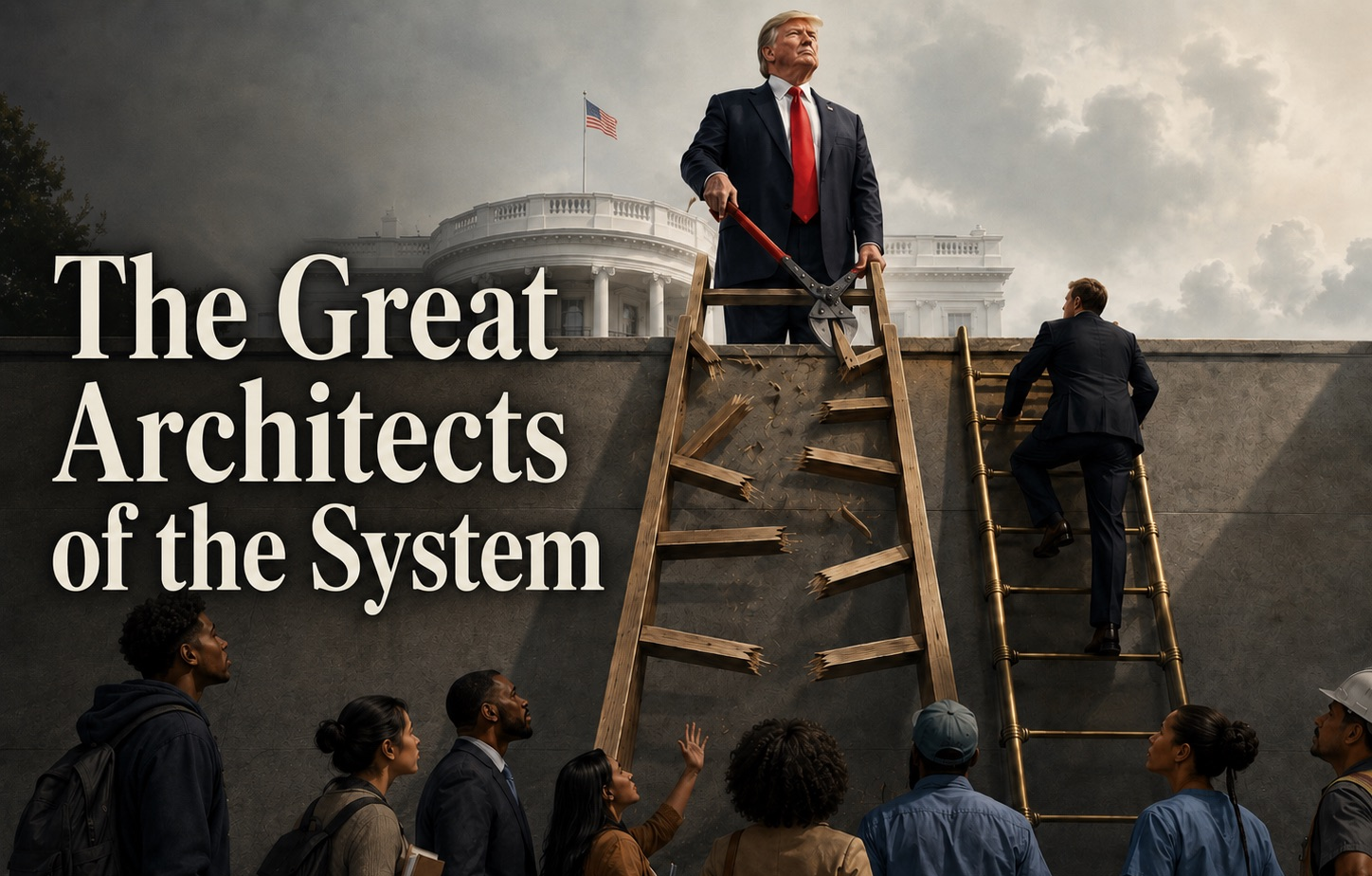
The attack on DEI is only one piece of a larger political pattern. From education to voting power, civil-rights enforcement, and historical memory, the Trump administration’s policies reveal a broader effort to weaken the roots of minority influence before it becomes permanent power.
How the rollback of affirmative action, DEI, civil-rights enforcement, historical memory, and voting power exposes a broader struggle over who is granted the legitimacy to shape America’s future.
The Trump administration’s attack on DEI, affirmative action, race-conscious admissions, civil-rights enforcement, Black historical memory, and minority voting power should not be viewed as a series of disconnected policy disputes. Viewed separately, each action can be defended with familiar language: merit, neutrality, fairness, tradition, patriotism, efficiency, or colorblindness.
But viewed together, a clearer pattern emerges.
This is not simply a debate about diversity programs. It is a struggle over who gets access to the institutions that produce power.
Education produces power. Voting produces power. Public office produces power. Historical memory produces power. Civil-rights enforcement produces power. Data collection produces power because it reveals who is being excluded. Congressional districts produce power because they decide whose community becomes politically visible and whose community is divided until it becomes weak.
That is why these areas are being targeted at the same time.
The argument sold to the public is simple: America must return to merit. But the deeper political effect is different. By attacking the tools that helped minorities enter schools, workplaces, government, museums, courts, and voting districts, the administration is not merely removing “identity politics.” It is weakening the legal and institutional bridges that allowed historically excluded groups to climb into decision-making spaces.
This is where the real battle is.
Minority communities did not gain influence overnight. They gained it through decades of legal fights, civil-rights protections, educational access, voting-rights enforcement, public pressure, and representation. Those tools did not create unfair advantage. They were created because the system had already been unfair for generations.
So when those tools are suddenly described as the problem, the question becomes obvious: problem for whom?
For communities that were historically locked out, DEI, affirmative action, voting protections, and civil-rights enforcement are not abstract political slogans. They are access points. They are doors. They are ladders. They are evidence-gathering mechanisms. They are legal weapons against invisible discrimination.
For those who benefited from the old structure, however, those same tools look like a threat.
That is the central contradiction. The administration claims it is restoring fairness, but the policies repeatedly move in one direction: away from minority access and back toward institutional control by the existing power structure.
The attack on DEI reduces minority entry into professional and educational pipelines.
The attack on affirmative action narrows race-conscious remedies in admissions.
The attack on disparate-impact liability weakens one of the most important legal tools for challenging policies that appear neutral but produce unequal results.
The pressure on museums and public history reshapes national memory by reducing the visibility of slavery, segregation, systemic racism, and Black resistance.
The weakening of workforce race and gender data collection makes discrimination harder to prove because what is not measured is easier to deny.
The redrawing of congressional districts can split Black communities apart, reducing their ability to elect representatives of their choice.
The blocking or obstruction of Black political leadership, as seen in cases like Newbern, Alabama, shows how local power can resist democratic outcomes when a Black candidate actually gains authority.
Each move touches a different institution. But the direction is the same: reduce the tools that allow minorities to transform population, education, and civic participation into actual power.
That is why this is bigger than policy. It is a counter-revolution against minority ascension.
Democracy, when it functions honestly, slowly redistributes influence. It allows people once excluded from power to organize, vote, study, lead, govern, and rewrite the national story with their own presence. That is the promise of democracy. But it is also the reason democracy becomes threatening to those who confuse their dominance with national stability.
When minorities gain access to education, they compete for elite credentials.
When they gain access to voting rights, they change electoral outcomes.
When they gain access to public office, they influence budgets, laws, policing, schools, and courts.
When they gain access to historical institutions, they challenge the sanitized version of national memory.
When they gain access to civil-rights enforcement, they force institutions to explain unequal outcomes.
That is the point where democracy stops being symbolic and becomes material.
The backlash begins when representation is no longer decorative. A minority face on a brochure is acceptable. A minority vote deciding an election is not. A minority student in a university photo is acceptable. A minority class reshaping elite education is not. Black history as a celebration is acceptable. Black history as an indictment of national systems is not. Diversity as performance is tolerated. Diversity as power is resisted.
This is why the language of “merit” must be examined carefully.
Merit sounds neutral. But in a society built on unequal access, merit can become a shield for inherited advantage. If one group had generations of better schools, better neighborhoods, stronger networks, family wealth, political protection, and institutional familiarity, then removing corrective tools does not create fairness. It freezes the advantage already in place.
That is the quiet violence of so-called neutrality. It pretends the race is fair after some runners have been held back for centuries.
The same logic applies to history. A country that removes uncomfortable truths from museums and public lands is not becoming more patriotic. It is becoming more fragile. It is trying to protect national pride from national evidence.
History is not dangerous because it divides people. History is dangerous because it explains power. It shows who built the country, who was exploited, who was excluded, who resisted, and who inherited the benefits. Once people understand that, they stop accepting inequality as natural.
That is why controlling memory is part of controlling the future.
The same is true with voting districts. A vote is not only an individual act. It is collective power. If Black communities are broken apart across maps, their numbers remain the same, but their political strength is weakened. That is not democracy expanding. That is democracy being engineered.
This is the larger picture: the administration’s project is not simply to win elections. It is to reshape the conditions under which future elections, future schools, future workplaces, future courts, and future historical narratives operate.
In other words, the mission is not only to regain votes. It is to regain the roots of power.
Control the schools, and you control who enters elite society.
Control civil-rights enforcement, and you control who can challenge discrimination.
Control historical memory, and you control what the country believes about itself.
Control voting maps, and you control which communities can convert numbers into representation.
Control public institutions, and you control who appears legitimate.
This is why the pattern matters. A single policy can be explained away. A sequence of policies reveals direction.
And the direction is clear: reduce minority influence before it becomes permanent political power.
The deeper question is whether American democracy was ever designed to accept full equality once full equality began changing who holds authority. It is easy for a system to praise democracy when the same groups keep winning. The real test begins when democracy produces new leaders, new voters, new narratives, and new priorities.
That is the moment when the mask slips.
If democratic access allows minorities to rise naturally through education, voting, law, culture, and public office, then the existing power structure faces a choice. It can share power, or it can change the rules while still calling the system democratic.
The Trump administration’s actions suggest a fear not of disorder, but of replacement within the rules of democracy itself. Not replacement by invasion. Not replacement by conspiracy. Replacement by participation.
Not because it destroys democracy, but because it proves democracy can dissolve inherited dominance when access becomes real.
So the question is not whether democracy is under pressure. The question is whether democracy is only accepted when it protects the old hierarchy. If equal access begins to produce equal power, and the response is to dismantle the mechanisms that made that access possible, then the system is not defending merit. It is defending control.
That is the pattern.
And once the pattern is visible, the debate changes. This is not about isolated reforms. It is about whether America will allow the communities it once excluded to become full architects of the country’s future, or whether the language of neutrality will be used to push them back before they reach the center of power.
What we’re witnessing is not a clash of good versus evil, but a confrontation between actors operating with the same playbook, pressure, leverage, and calculated destabilization. The difference isn’t behavior. It’s permission. Who gets a pass, and who gets punished for doing the same thing.
For decades, the global order, largely shaped by the United States Department of Defense and reinforced through alliances like NATO, was framed as “stability.”
That word deserves scrutiny.
Because what was labeled stability was, in practice, enforced dominance.
At its peak, the U.S. maintained over 800 military bases across more than 70 countries. The Fifth Fleet in Bahrain didn’t simply protect peace, it secured control over the Strait of Hormuz, where roughly 20% of the world’s oil supply transits daily.
That isn’t neutrality. That’s leverage.
And leverage always serves the one holding it.
Now that leverage is being tested, the language is shifting.
Iran has not replaced U.S. power, but it has exposed its limits. Reach has expanded. Costs of disruption have dropped. Influence no longer requires direct confrontation. Even the International Monetary Fund has warned that prolonged instability in the region could trigger global economic shock through energy volatility and supply disruption.
“America has no permanent friends or enemies, only interests.”
That logic didn’t fade. It became the system.
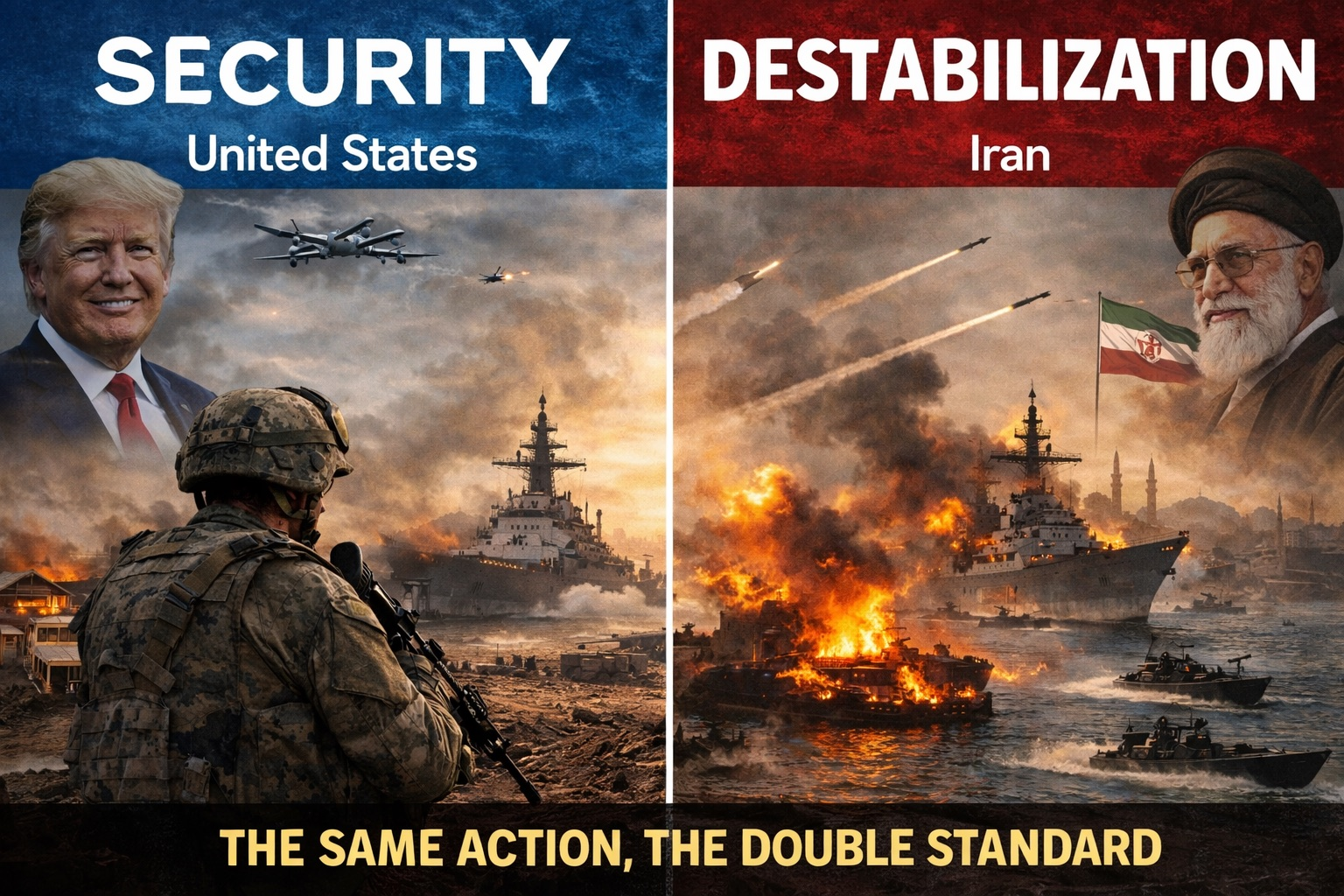
So when the U.S. pressures a corridor, it’s “security.” When Iran does the same, it’s “destabilization.”
Same mechanism. Different label.
And that label is the shield.
Because language is how power protects itself.
Even “freedom of navigation” is conditional, applied as principle when aligned, framed as crisis when challenged.
This isn’t accidental. It’s structural.
As John Mearsheimer argues, great powers are driven to dominate, not out of ideology, but because the system rewards it.
Iran isn’t breaking the rules.
It’s operating within them.
And that’s what makes this moment destabilizing.
Because the system only holds when one actor can impose consequences without facing them.
That condition is fading.
What’s emerging is not the collapse of power, but the end of uncontested power.
And once dominance becomes contestable, the cost rises everywhere:
Deterrence demands constant escalation
Supply chains require rerouting and redundancy
Energy markets embed risk
Diplomacy becomes performance instead of function
This is how systems unravel, not through sudden collapse, but through rising cost that exposes their limits.
And at the center of it is not strategy, but ego.
Leadership that confuses pressure with control. Institutions clinging to narratives that no longer match reality.
The outcome is already visible:
Escalation without control. Power without certainty. Cost without accountability.
Let’s be clear.
The world is not becoming more moral.
It is becoming more transparent.
The United States is not uniquely aggressive. Iran is not uniquely destabilizing.
Both operate on the same logic:
Apply pressure. Control flow. Shift cost.
The only thing changing is permission.
Who can act without consequence, and who cannot.
And that shift, more than any strike or deployment, is what is reshaping the global order.
Because once the illusion of control fades, power doesn’t disappear.
It gets negotiated.
Let’s stop pretending this is about morality.
What we are watching unfold is not a clash between right and wrong, it is a transfer of leverage between two powers that ultimately speak the same language: force, pressure, and control. The only difference is tolerance, who the system allows to act without consequence, and who it labels a threat for doing the same.
For decades, U.S. “stability” in the Middle East was never neutral. It was enforced dominance. Military bases, naval fleets, and security guarantees didn’t create peace, they created compliance. The flow of oil through the Strait of Hormuz remained smooth not because the system was fair, but because it was controlled.
And controlled systems always benefit someone.
Now that control is being challenged.
Iran has not replaced U.S. power, but it has exposed its limits. Bases that once symbolized untouchable authority are now within reach. Supply lines once considered secure now carry risk. The system didn’t collapse, it lost its certainty. And once certainty disappears, dominance becomes negotiation.
Call it disruption. Call it escalation. But don’t call it new behavior.
Because the mechanism is the same.
Pressure the corridor. Influence the flow. Shift the cost.
The difference is that when one actor does it, it’s called “security.” When the other does it, it’s called “destabilization.”
Same action. Different label.
And that label determines who gets tolerated, and who gets punished.
Meanwhile, the cost is exploding.
This war is no longer measured in missiles alone. It is measured in:
tens, if not hundreds, of billions in military expenditure
rising insurance premiums on global shipping
energy markets pricing in permanent instability
supply chains slowing under geopolitical risk
The global economy is now absorbing the consequences of a system that believed it could operate indefinitely without pushback.
And at the center of this acceleration is not strategy, but ego.
The collapse of diplomacy is not accidental. It is the result of leadership that mistakes pressure for control, and arrogance for strength. When negotiation is replaced by posturing, escalation becomes inevitable, and expensive.
This is how systems break, not through sudden collapse, but through rising cost that no one wants to admit is unsustainable.
The uncomfortable truth is this:
The world is not entering a new moral order. It is entering a more honest one, where power is no longer hidden behind language, and control is no longer uncontested.
The U.S. is not uniquely aggressive. Iran is not uniquely disruptive.
They are operating within the same logic.
The only thing changing is who gets away with it.
And that shift, more than any missile or strike, is what is shaking the system.
At first glance, the alliance between the United States and Israel appears counterintuitive when measured against traditional indicators of national strength. Unlike many of its regional counterparts, Israel does not possess abundant natural resources. It lacks significant oil reserves, faces chronic freshwater scarcity, and operates within a largely arid environment where natural agricultural expansion is structurally limited.
To compensate, the country has invested heavily in large-scale desalination infrastructure, transforming seawater into potable supply. This system is technologically advanced and widely regarded as one of the most efficient in the world. However, it comes at a measurable cost: estimates suggest Israel spends hundreds of millions of dollars annually operating its desalination network, with long-term contracts and energy inputs pushing total lifecycle costs even higher. The system sustains agricultural and urban demand that would otherwise be constrained—effectively engineering resilience rather than drawing from naturally abundant conditions.
This raises a structural question when examining Israel’s positioning as a global technology hub. Advanced infrastructure, particularly data centers, semiconductor activity, and high-performance computing, requires stable access to both water and energy. While Israel has compensated through innovation, scaling such infrastructure domestically remains resource-intensive. As a result, long-term technological expansion may increasingly depend on outward integration, through partnerships, offshore infrastructure, or by extending influence into neighboring regions via colonization, territorial encroachment, or enforced economic expansion where natural resource conditions are more favorable.
In that sense, growth does not occur purely within borders, but through projection beyond them.
From a demographic and structural standpoint, Israel also operates within constraints. Its relatively small population limits total labor capacity and military depth when compared to larger regional actors. These limitations are offset through high levels of training, technological integration, and strategic doctrine, but the issue of scale remains structural rather than temporary.
The question of advanced military capability introduces an additional layer of complexity. Israel is widely understood to possess nuclear capabilities, although it maintains a policy of deliberate ambiguity. The development of such systems historically requires decades of research, deep scientific infrastructure, and cumulative generational knowledge. Given Israel’s relatively recent statehood, this has led to long-standing assessments that external cooperation—particularly with the United States, played a role in accelerating technological and defense maturity, directly or indirectly.
Similarly, while Israel maintains a highly advanced military, a significant portion of its equipment, fighter aircraft, missile defense systems, naval assets, and munitions—is either imported, co-developed, or heavily financed through external support. The United States provides approximately $3.8 billion annually in military aid, in addition to joint development programs and access to advanced systems. When factoring procurement, maintenance, and replenishment of high-intensity military operations, the broader cost structure of sustaining Israel’s defense posture extends well beyond its domestic production base.
This raises a fundamental accounting question: what is the true cost of military independence when core components are financed, supplied, or technologically enabled by an external power?
Which brings us back to the foundation of the alliance.
If not resource wealth, not demographic scale, and not fully self-contained industrial capacity, the answer increasingly points toward geography. Israel occupies a uniquely strategic position at the crossroads of the Eastern Mediterranean and the Middle East, within proximity to critical trade routes, energy corridors, and geopolitical fault lines. In this sense, its value may derive less from internal abundance and more from its role as a forward-positioned strategic anchor for the United States.
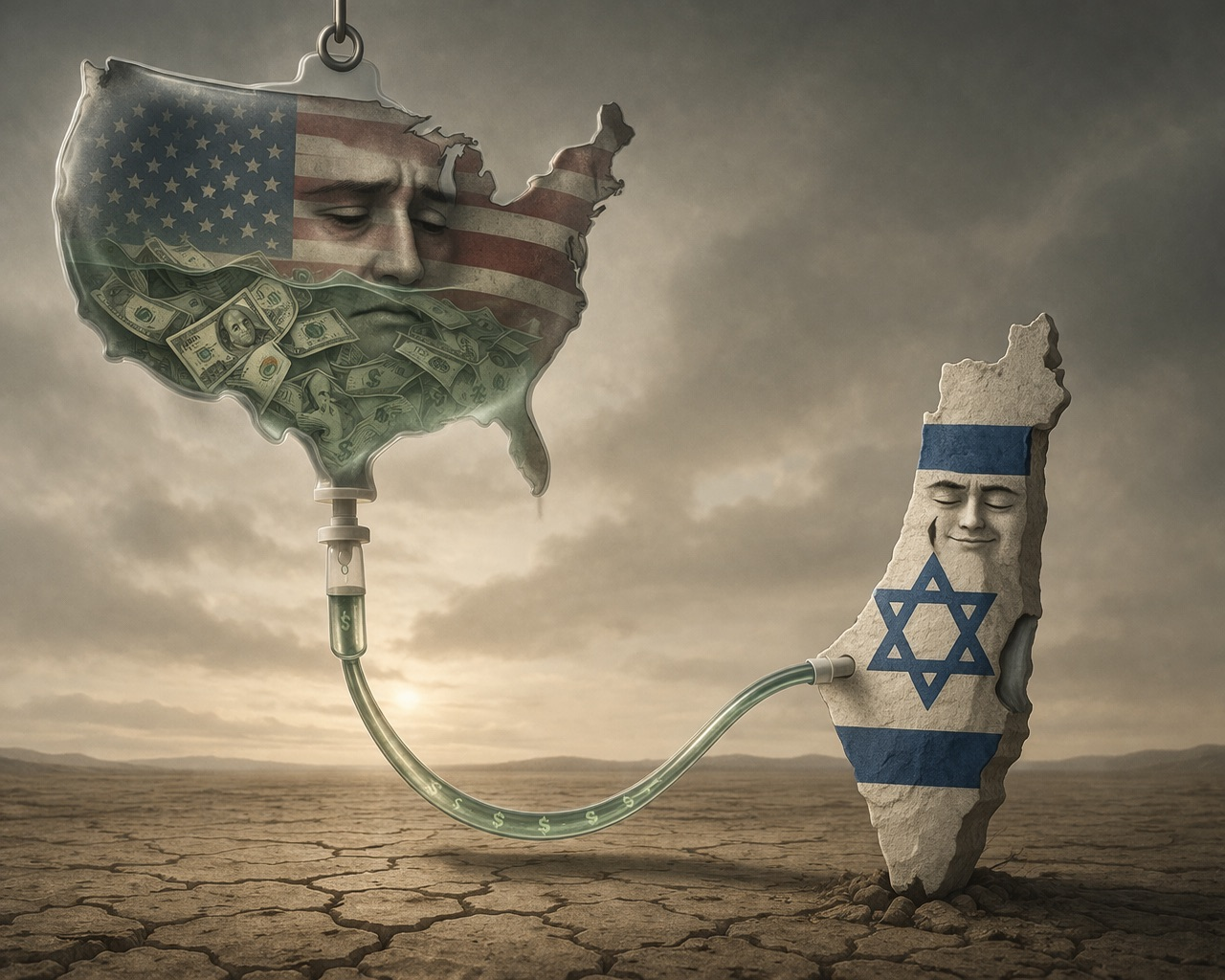
However, when viewed through this lens, the relationship begins to resemble structural asymmetry. Israel’s resilience, economic, military, and infrastructural, appears, at least in part, externally reinforced. The system functions not purely as mutual strength, but as sustained alignment supported by continuous input.
This leads to a broader reflection: whether the alliance is truly grounded in balanced power, or whether it reflects a strategic placement maintained through ongoing support, what could be interpreted as a form of geopolitical life support for the only non-Muslim-majority state in the region, rather than purely independent leverage.
Which raises a more uncomfortable question.
Why does Israel project such a high degree of authority, confidence, and unilateral power, when, on paper, many of its core systems, water, defense, advanced equipment, and even aspects of technological scaling, are either engineered, externally supported, or partially dependent on outside inputs?
It is not that Israel lacks capability. It is that much of that capability exists within a framework where key advantages are reinforced from beyond its borders.
A state where resilience is, to a significant extent, constructed.
Where sustainability is engineered.
And where strategic strength may be less organic than it appears, raising the question of whether what is being sustained is not just a nation, but a position.







 Entertainment1 year ago
 Opinion1 year ago
 Politics1 year ago
 Tech1 year ago
 Economy1 year ago
 Sports1 year ago
 Entrepreneur1 year ago
 Opinion11 months ago